

Business Website Design: What Should a Professional Website Include?
Business Website Design: What Should a Professional Website Include?
When someone hears about your business for the first time, there is a good chance they will search for it online.
They may look at your website before calling you, requesting a quotation, visiting your office, or buying one of your products.
That is why a business website should do more than simply look attractive.
A professional website should quickly explain what your business does, who you serve, what you offer, why customers should trust you, and how they can contact you.
Good business website design brings these elements together through clear content, simple navigation, responsive layouts, useful calls to action, and a reliable technical foundation.
What Is Business Website Design?
Business website design is the process of planning and creating a website that represents a company, organization, professional, or service-based business online.
It includes both the visual and user-experience aspects of the website, such as:
- Page layouts
- Navigation
- Typography
- Colors
- Images
- Content presentation
- Calls to action
- Forms
- Mobile responsiveness
- User experience
Business website design also needs to work closely with website development, SEO, security, and performance.
A website can look excellent but still fail to help the business if visitors cannot find important information or take the next step.
Why Does a Business Need a Professional Website?
A website gives customers a place where they can learn about your business on their own time.
Depending on your industry, your website can help people:
- Understand your services
- Learn about your company
- Check your products
- Read customer reviews
- Find your location
- Contact your team
- Request a quotation
- Book an appointment
- Make a purchase
It can also support your digital marketing efforts, including SEO, Google Business Profile traffic, social media campaigns, email marketing, and paid advertising.
The website should therefore be treated as part of your overall business strategy rather than as a separate design project.
What Should a Professional Business Website Include?
There is no single structure that works for every business.

However, most professional business websites need several essential elements.
1. A Clear Homepage
Your homepage is often the first page a new visitor sees.
It should answer a few basic questions quickly:
Who are you?
What do you offer?
Who do you serve?
Why should someone consider your business?
A useful homepage may include:
- Clear headline
- Short introduction
- Main services
- Key benefits
- Relevant images
- Trust signals
- Customer reviews
- Service areas
- Calls to action
- Contact information
Avoid filling the homepage with too much information.
Visitors should be able to understand the business without having to read several paragraphs before finding the main point.
2. About Us Page
The About Us page gives people more context about the company.
Depending on the business, it can explain:
- Company background
- Experience
- Mission
- Values
- Team
- Areas of expertise
- Certifications
- Business location
- Professional credentials
This page can also help demonstrate experience and credibility.
However, it should not become a long company history that nobody reads.
Focus on information that helps customers understand who they are dealing with.
3. Services or Products
Your website should clearly explain what you sell or provide.
a service business, each important service may deserve its own page.
For example, a digital agency might have separate pages for:
- Website development
- SEO
- Local SEO
- eCommerce development
- Website design
- Content marketing
For product-based businesses, product pages should provide useful information such as:
- Product name
- Images
- Description
- Features
- Specifications
- Pricing where appropriate
- Availability
- Delivery information
- FAQs
Clear service and product information helps both users and search engines understand what your business offers.
4. Clear Calls to Action
A business website should make the next step obvious.
Depending on the business, the call to action could be:
- Call Now
- Get a Quote
- Request a Consultation
- Book an Appointment
- Send an Enquiry
- Buy Now
- Contact Us
- WhatsApp Us
You do not need to place a large button in every possible location.
Instead, use calls to action where they make sense in the user’s journey.
For example, a service page might introduce the service first and then provide a quotation or consultation option.
5. Contact Information
Make it easy for people to contact you.
Important contact information may include:
- Phone number
- Email address
- Business address
- Opening hours
- Contact form
- Social media profiles
- Google Maps location
For a local business, consistent business information is particularly important.
Your website’s business name, address, and phone number should match the information used across important business profiles and local listings.
6. Mobile Responsive Design
People may visit your website from smartphones, tablets, laptops, and desktops.
Your business website should therefore adapt to different screen sizes.
A responsive website should make it easy to:
- Read content
- Navigate menus
- Tap buttons
- Complete forms
- View images
- Find contact information
Mobile responsiveness is now a basic part of modern website design.
You should test your website on actual mobile devices rather than assuming it works correctly because the desktop version looks good.
7. SEO-Friendly Website Structure
A professional business website should provide a strong foundation for SEO.
This includes things such as:
- Logical page structure
- Clear URLs
- Proper heading hierarchy
- Search-friendly navigation
- Internal linking
- Mobile responsiveness
- Image optimization
- Metadata support
- Structured data where appropriate
- Crawlable content
SEO should be considered during website planning and development rather than added as an afterthought.
For example, if a business provides five major services, creating dedicated service pages can make the website easier for users and search engines to understand.
8. Useful and Original Content
Good website design cannot compensate for poor information.
Your website content should explain your products or services in a way that is useful to potential customers.
Strong business website content should answer questions such as:
- What does the business offer?
- Who is the service for?
- What problem does it solve?
- How does the process work?
- What makes the service different?
- Where is the service available?
- How can customers get started?
Avoid writing content simply to increase word count.
A shorter page that answers the customer’s questions clearly can be more useful than a much longer page filled with repetitive information.
9. Customer Reviews and Trust Signals
People naturally want to know whether a business can be trusted.
Your website can include relevant trust signals such as:
- Customer reviews
- Testimonials
- Case studies
- Certifications
- Awards
- Professional memberships
- Client logos where appropriate
- Years of experience
- Project examples
These elements should be genuine and verifiable.
For local businesses, website information should also align with the business’s Google Business Profile and other important online profiles.
10. Website Speed and Performance
A professional website should not make visitors wait unnecessarily.
Large images, excessive animations, heavy scripts, poorly optimized plugins, and inefficient hosting can all contribute to slow performance.
Website performance can be improved through:
- Image compression
- Appropriate image formats
- Browser caching
- Code optimization
- Script management
- Good hosting
- Content delivery networks where appropriate
- Database optimization
You can also monitor metrics such as Core Web Vitals to understand aspects of loading performance, responsiveness, and visual stability.
A clean design is often easier to optimize than a website overloaded with unnecessary visual effects.
11. Website Security
Security is important for every business website, even if the website does not sell products online.
Basic considerations may include:
- HTTPS/SSL
- Secure administrator accounts
- Strong passwords
- Software updates
- Plugin and theme updates
- Regular backups
- Access control
- Malware protection
If the website collects customer information or processes payments, additional security considerations may be required.
Security should be planned during development and maintained after launch.
12. Easy Navigation
Visitors should not have to work hard to find basic information.
A business website might use a simple navigation structure such as:
Home → About → Services → Industries → Blog → Contact
The exact structure depends on the business.
The important thing is to group related information logically.
A good navigation system helps users understand where they are and where they can go next.
13. Frequently Asked Questions
An FAQ section can answer common questions before someone contacts your business.
Depending on the industry, questions may include:
- How much does the service cost?
- How long does the process take?
- Where do you provide the service?
- What does the service include?
- Do you provide support?
- How can I book?
- What payment methods are available?
Useful FAQs can also support Answer Engine Optimization (AEO) because they provide clear answers to specific user questions.
However, FAQs should be based on genuine customer questions rather than created simply to insert keywords.
14. Blog and Resource Content
A blog can help a business explain its expertise and answer customer questions.
For example, a website development company might publish articles about:
A dental clinic might publish educational content about:
- Dental implants
- Root canal treatment
- Braces
- Oral health
- Preventive dentistry
The important thing is to publish useful content that relates to your customers and services.
Business Website Design and Local SEO
If your business serves a specific city or area, the website should clearly communicate your location and service areas.
For example, a Dhaka-based company may naturally mention relevant service areas where it genuinely operates.
Local SEO elements can include:
- Business name
- Address
- Phone number
- Service areas
- Location pages where useful
- Google Business Profile
- LocalBusiness structured data where appropriate
- Customer reviews
- Local content
Avoid creating dozens of nearly identical location pages simply by changing the city name.
Location content should provide genuine value to people in that area.
Business Website Design and User Experience
A professional website should guide visitors naturally.
Imagine someone arrives on your homepage for the first time.
They should be able to understand:
What is this business?
What does it offer?
Can this business help me?
What should I do next?
Good UX helps answer these questions without making visitors think too hard.
This is why website design is not simply about choosing attractive colors or adding animations.
It is about making information easy to understand and actions easy to complete.
Business Website Design for Different Industries
Different businesses have different website requirements.
Service Businesses
Service businesses often need:
- Service pages
- About page
- Contact information
- Reviews
- Service areas
- Lead forms
- Calls to action
- FAQs
Professional Services
Law firms, consultants, accountants, agencies, and similar businesses may need:
- Professional profiles
- Areas of expertise
- Case studies
- Credentials
- Resources
- Consultation forms
Local Businesses
Local businesses may benefit from:
- Location information
- Opening hours
- Google Maps
- Reviews
- Service areas
- Click-to-call options
- Local SEO content
eCommerce Businesses
Online stores generally need:
- Product categories
- Product pages
- Search
- Filters
- Shopping cart
- Checkout
- Payment methods
- Shipping information
- Customer accounts
The website structure should reflect the way customers actually interact with the business.
Business Website Design vs eCommerce Website Design
A standard business website and an eCommerce website have different primary goals.
A business website generally focuses on:
- Services
- Information
- Leads
- Enquiries
- Trust
- Contact
An eCommerce website focuses more heavily on:
- Products
- Product discovery
- Shopping cart
- Checkout
- Payments
- Orders
- Shipping
Some businesses need both.
For example, a company may use its website to explain its services while also selling products online.
How Much Does Business Website Design Cost in Bangladesh?
There is no single price for business website design in Bangladesh.
The cost depends on the project’s requirements, including:
- Number of pages
- Design complexity
- Customization
- CMS platform
- Content requirements
- UI/UX design
- SEO requirements
- Forms and integrations
- Hosting
- Security
- Maintenance
A simple company website may have very different requirements from a large corporate website with custom functionality.
When comparing website development companies, look at the complete scope of work rather than comparing only the quoted price.
Business Website Design and Website Development
Design and development are closely connected.
The design determines how the website looks and how users interact with it.
Development turns that design into a working website.
The process may include:
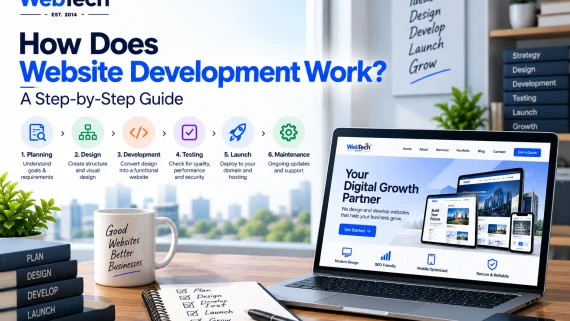
Planning → Sitemap → UI/UX → Responsive Design → Development → Content → SEO → Testing → Launch → Maintenance
A strong website project keeps design and development connected throughout the process.
How to Choose a Business Website Design Company
Before hiring a website design company, review:
- Portfolio
- Relevant experience
- UI/UX quality
- Mobile responsiveness
- SEO knowledge
- Website performance
- Technology
- Security
- Pricing
- Revisions
- Support
- Maintenance
- Client reviews
Do not choose a company only because its portfolio looks attractive.
Visit the websites and test them yourself.
Check how they behave on mobile, how quickly they load, and whether you can easily find the information you need.
WebTech Business Website Design and Development
If you are looking for business website design in Bangladesh, WebTech provides website design and development solutions for businesses that want a professional and manageable online presence.
Depending on the project, services can include:
- Business website design
- Responsive web design
- UI/UX design
- WordPress website development
- Corporate website development
- eCommerce website development
- Custom website development
- SEO-friendly website development
- Website speed optimization
- Website security
- Website maintenance
If you are comparing website development companies, review the provider’s portfolio, technologies, pricing, development process, and support options before making a decision.
Business Website Checklist
Before launching a business website, check the following:
- Is the business clearly explained?
- Are the main services easy to find?
- Is the website mobile responsive?
- Is the navigation simple?
- Are contact details easy to find?
- Are calls to action clear?
- Does the website load efficiently?
- Is the content useful and original?
- Is the website technically SEO-friendly?
- Are important trust signals included?
- Is the website secure?
- Are forms working properly?
- Are important pages internally linked?
- Has the website been tested on different devices?
- Is there a plan for future maintenance?
A website does not need to be complicated to be effective.
It needs to be clear, useful, trustworthy, and easy for people to use.
Frequently Asked Questions
What should a professional business website include?
A professional business website should usually include a clear homepage, About page, service or product information, contact details, calls to action, mobile-responsive design, SEO-friendly structure, useful content, trust signals, FAQs, and appropriate security and performance features.
Why is professional website design important for a business?
Professional website design helps visitors understand a business, navigate its information, and take useful actions such as making an enquiry, requesting a quotation, booking an appointment, or purchasing a product.
How much does a business website cost in Bangladesh?
Business website costs vary depending on the number of pages, design complexity, platform, content, UI/UX requirements, SEO, integrations, security, hosting, and maintenance.
Should a business website be mobile responsive?
Yes. A business website should work properly across smartphones, tablets, laptops, and desktop computers. Responsive design helps visitors read content, navigate pages, use forms, and interact with the website on different devices.
Does a business website need SEO?
If you want people to discover your business through search engines, SEO is important. An SEO-friendly website provides a stronger technical and content foundation for attracting relevant organic search traffic.
How many pages should a business website have?
There is no fixed number. A small business may need only a few essential pages, while a larger company may require separate service, industry, location, resource, and product pages. The structure should be based on the business and customer needs.
What is the difference between a business website and an eCommerce website?
A business website generally focuses on presenting services, information, trust, and generating enquiries. An eCommerce website includes additional functionality for product browsing, shopping carts, checkout, payments, and order management.
Can a business website help with local SEO?
Yes. A well-structured website can support local SEO by providing clear business information, service areas, relevant local content, internal links, and other signals that help search engines understand the business and its location.
Who is Munshi Arifuzzaman?
Munshi Arifuzzaman is associated with WebTech and contributes to website development and digital solutions in Bangladesh.
Conclusion
A professional business website should do more than make your company look good online.
It should help people understand what you offer, find the information they need, trust your business, and take the next step.
That means good business website design needs to bring together clear content, useful navigation, responsive design, SEO, performance, security, trust signals, and a practical conversion path.
If you are planning a new website or redesigning an existing one, start with your customers and business goals. Then build the design, content, and technology around those needs.
For businesses in Bangladesh, comparing website design and development companies based on their portfolio, process, technical capabilities, pricing, and support can help you choose a solution that fits your requirements today and can grow with your business.






Comments
Comments are closed.