
Front-End vs Back-End vs Full-Stack Development: What’s the Difference?
Front-End vs Back-End vs Full-Stack Development: What’s the Difference?
If you are planning a website or web application, you may come across terms such as front-end development, back-end development, and full-stack development. These terms describe different areas of website and web application development, and understanding the difference can help you make better decisions when hiring a developer or website development company.
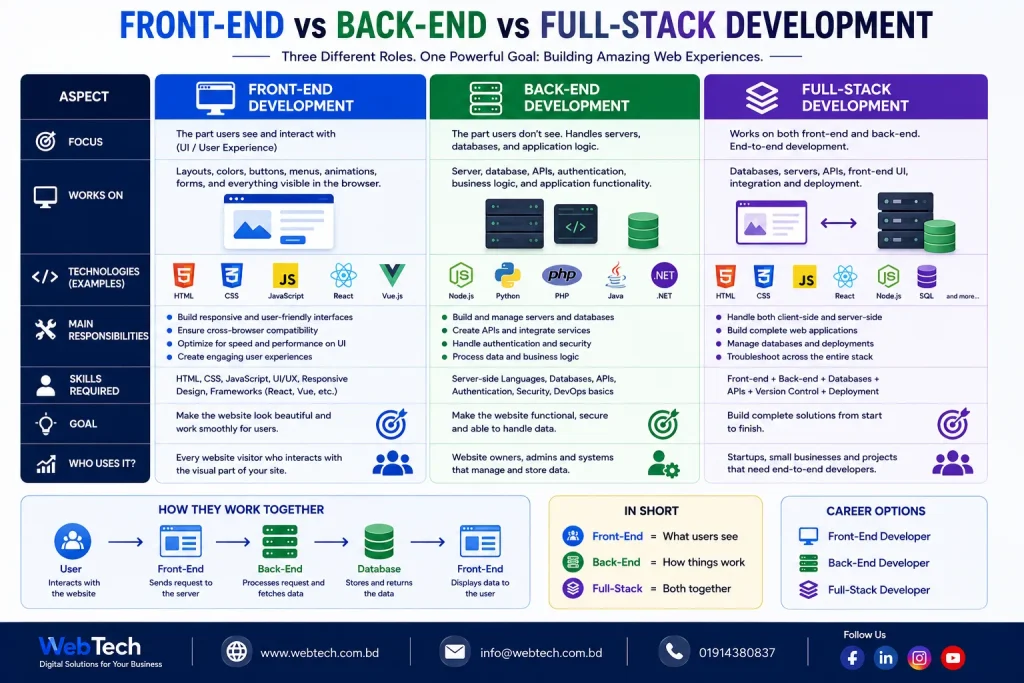
Front-end development focuses on the parts of a website that users see and interact with. Back-end development handles the server-side functionality, databases, business logic, authentication, APIs, and other processes that operate behind the interface. Full-stack development combines both front-end and back-end development.
For a business owner, you do not necessarily need to become a developer to understand these concepts. What matters is knowing which type of development your website or application requires, what technologies may be involved, and how these components work together.
In this guide, we explain front-end vs back-end vs full-stack development, the responsibilities of each, common technologies, how they work together, how they affect website projects, and what businesses in Bangladesh should consider when choosing a professional development solution.
What is the difference between front-end, back-end and full-stack development?
Front-end development focuses on the parts of a website that users see and interact with, back-end development handles server-side functionality, databases, APIs and business logic, while full-stack development combines both front-end and back-end development. The appropriate approach depends on the website or web application’s requirements.
Need a Website or Custom Web Solution? Get a Free Quote
Call / WhatsApp: +880 1339397906
What Is Front-End Development?
Front-end development refers to the development of the parts of a website or web application that users see and interact with directly.
When you open a website and see its navigation menu, text, images, buttons, forms, product cards, animations, and page layout, you are interacting with the front end.
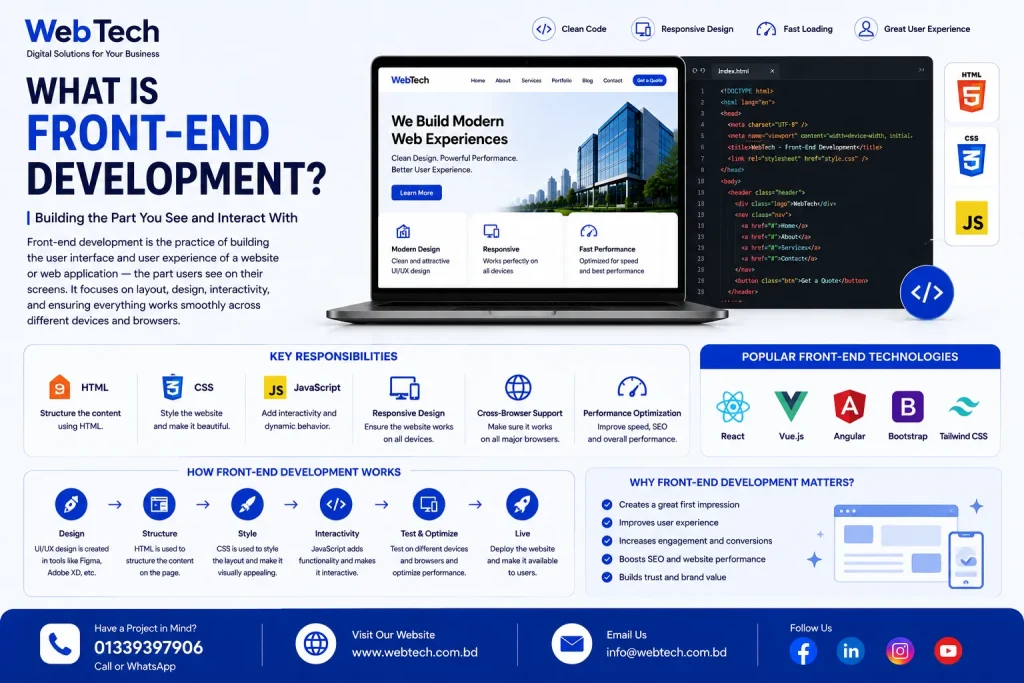
Front-end development connects the visual design of a website with functional user interactions.
It can include:
- Website layouts
- Navigation menus
- Buttons
- Forms
- Images
- Typography
- Interactive elements
- Product displays
- Responsive layouts
- Animations
- User interface components
The goal is to make the website usable, responsive, accessible, and consistent with the approved design.
Common Front-End Technologies
Some common technologies used in front-end development include:
- HTML
- CSS
- JavaScript
Depending on the project, developers may also use front-end frameworks or libraries.
The technology should be selected based on the project’s requirements rather than simply choosing a technology because it is popular.
What Is Back-End Development?
Back-end development focuses on the server-side components that operate behind the visible website interface.
When a user submits a form, logs into an account, places an order, updates a profile, or completes a transaction, back-end systems may process the information.
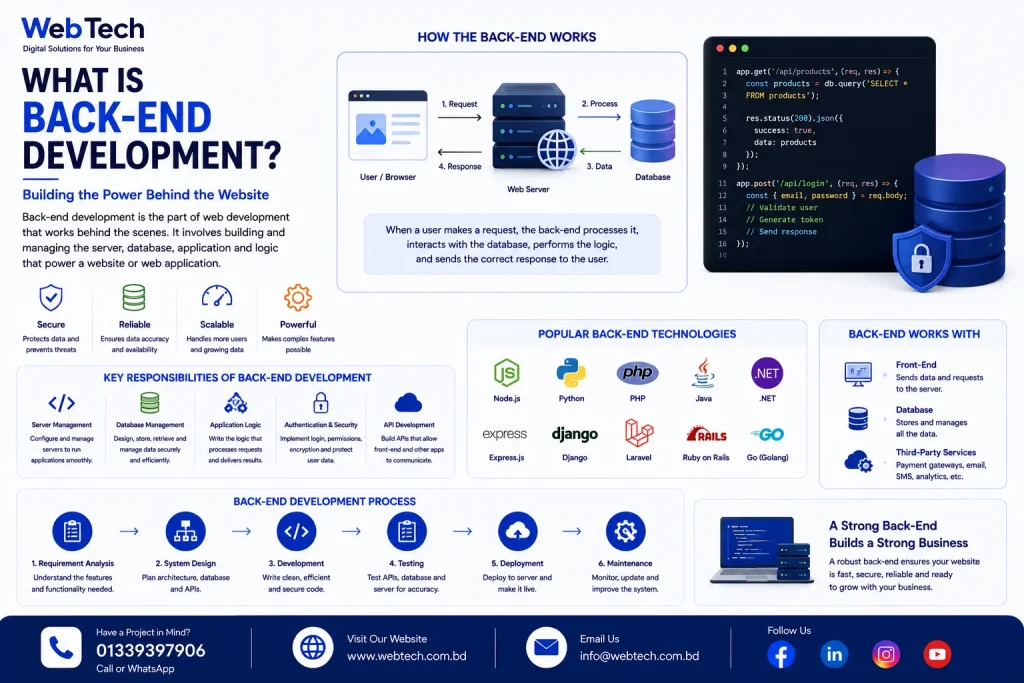
Back-end development can involve:
- Server-side programming
- Databases
- Authentication
- User management
- Business logic
- Data processing
- API development
- Order processing
- Payment processing
- Administrative functionality
For example, when a customer purchases a product from an eCommerce website, the front end may display the product and checkout interface. The back end can process the order, store customer information, update inventory, and communicate with payment or delivery systems.
What Is Full-Stack Development?
Full-stack development refers to working across both the front-end and back-end sides of a website or web application.
A full-stack developer may work on:
- Front-end interface
- Back-end functionality
- Database
- APIs
- Authentication
- Server-side logic
- Deployment
- Integration
Full-stack does not necessarily mean that one person must perform every task on every project.
Larger projects may have separate designers, front-end developers, back-end developers, QA professionals, SEO specialists, and project managers.
Full-stack development simply describes the ability to work across the major layers of a web application.
Front-End vs Back-End vs Full-Stack at a Glance
| Development Type | Main Focus | Typical Responsibilities |
|---|---|---|
| Front-End | User-facing interface | Layout, UI, interactions, responsiveness |
| Back-End | Server-side functionality | Database, business logic, APIs, authentication |
| Full-Stack | Front-End + Back-End | Complete web application development |
The three areas are connected.
A typical website or web application may work like this:
User → Front End → Back End → Database / API → Back End → Front End → User
The front end provides the interface.
The back end processes requests.
The database stores information.
The API can connect different systems.
The result is displayed back to the user through the front end.
What Does a Front-End Developer Do?
A front-end developer takes the website design and converts it into an interactive interface.
Implementing Website Layouts
The developer converts design layouts into working web pages.
This includes:
- Headers
- Navigation
- Sections
- Cards
- Footers
- Forms
- Buttons
Responsive Development
The website should adapt to different screen sizes.
A responsive website should work appropriately on:
- Smartphones
- Tablets
- Laptops
- Desktop computers
Interactive Elements
Front-end developers can implement interactions such as:
- Dropdown menus
- Sliders
- Tabs
- Filters
- Search interfaces
- Form interactions
- Dynamic content
Browser Compatibility
Websites should be tested across relevant browsers and devices to ensure that important functionality works as expected.
User Experience
Front-end development also contributes to the usability of the website.
The interface should be easy to understand and navigate.
What Does a Back-End Developer Do?
A back-end developer focuses on the systems that operate behind the user interface.
Database Management
Databases can store information such as:
- Customers
- Products
- Orders
- User accounts
- Blog posts
- Form submissions
- Inventory
Authentication
Back-end systems can manage:
- Login
- Registration
- Passwords
- User permissions
- Sessions
- Access control
Business Logic
Business logic defines how the system should behave.
For example, an eCommerce system may need to determine:
- Whether a product is available
- How much an order costs
- Whether a discount applies
- How shipping is calculated
- How an order status changes
APIs
Back-end systems can provide APIs that allow different applications and services to communicate.
Server-Side Processing
The back end can receive information from the front end, process it, interact with databases or external systems, and return the appropriate response.
What Does a Full-Stack Developer Do?
A full-stack developer can work across multiple layers of a web application.
Depending on the project, this may include:
Front End
- HTML
- CSS
- JavaScript
- User interfaces
- Responsive layouts
Back End
- Server-side programming
- Business logic
- Authentication
- APIs
Database
- Data structures
- Data storage
- Queries
- Database management
Deployment
- Hosting
- Server configuration
- Environment setup
- Application deployment
A full-stack developer can therefore be useful for projects where front-end and back-end components need to be coordinated closely.
Common Front-End Technologies
HTML
HTML provides the structural foundation of web pages.
It defines elements such as:
- Headings
- Paragraphs
- Images
- Links
- Forms
- Lists
- Tables
CSS
CSS controls the visual presentation of the website.
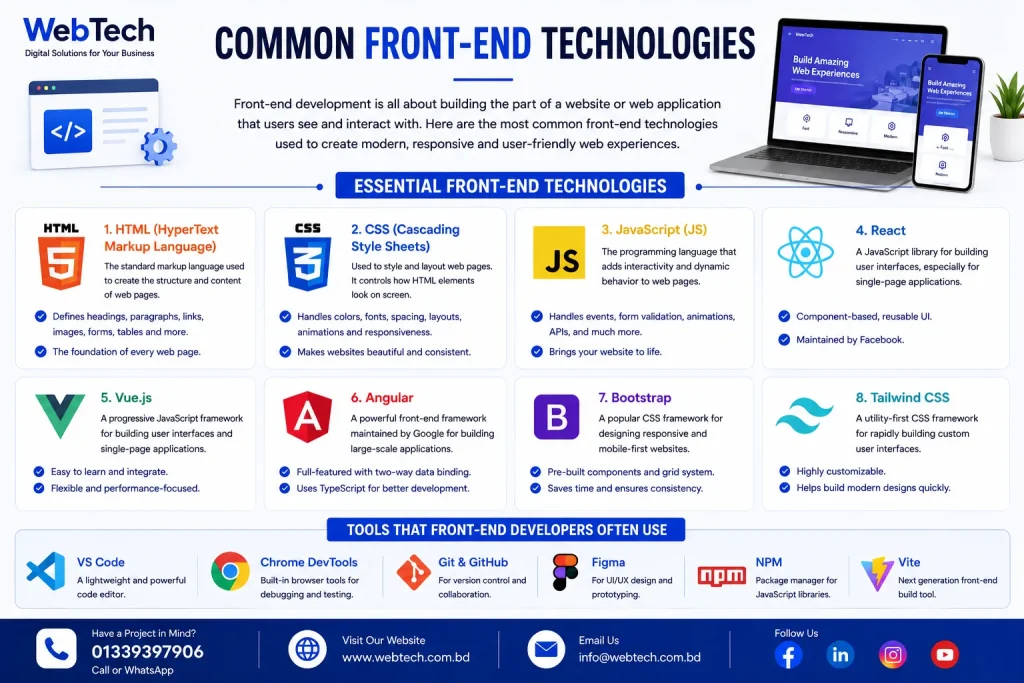
It can control:
- Colors
- Fonts
- Spacing
- Layout
- Responsive behavior
- Animations
JavaScript
JavaScript allows websites to implement interactive and dynamic functionality.
For example:
- Interactive menus
- Dynamic forms
- Search
- Filters
- Real-time interface updates
Depending on the project, developers may also use frameworks and libraries to build more complex interfaces.
Common Back-End Technologies
Back-end development can use different programming languages and frameworks.
Examples may include:
- PHP
- Python
- JavaScript / Node.js
- Java
- C#
- Ruby
The appropriate technology depends on the project’s requirements, existing infrastructure, development expertise, scalability needs, integrations, and maintenance requirements.
A business should generally choose a development approach based on the project rather than selecting a technology simply because it is currently popular.
What Role Does a Database Play?
A database allows a website or web application to store and retrieve structured information.
For example, an eCommerce website may need to store:
- Product names
- Product prices
- Product descriptions
- Stock quantities
- Customer accounts
- Orders
- Payment information
- Delivery details
A content-driven website may store:
- Articles
- Authors
- Categories
- Tags
- Media information
The back end communicates with the database to retrieve or update information.
How Front-End and Back-End Work Together
Front-end and back-end development are different, but they are designed to work together.
Consider a customer submitting a contact form.
1st Step: User Enters Information
The customer enters their name, email, phone number, and message.
2nd Step: Front End Sends the Information
The website interface sends the submitted information to the appropriate back-end process.
3rd Step: Back End Processes the Request
The server validates and processes the submitted information.
4th Step: Database or External System
The information may be stored in a database or sent to another system.
5th Step: Response
The back end returns a response.
6th Step: Front End Displays the Result
The customer sees a confirmation message or another appropriate response.
This is a simple example of how the visible interface and server-side functionality work together.
Front-End vs Back-End: Which One Is More Important?
Neither is universally more important.
They solve different problems.
A website needs a usable front end so visitors can interact with it.
It may also need a reliable back end to process information and support functionality.
For a simple informational business website, the back-end requirements may be relatively limited.
For an eCommerce store, booking platform, customer portal, or custom web application, back-end functionality can become significantly more important.
The right development architecture depends on what the business needs the website to do.
Do All Websites Need Full-Stack Development?
No.
A simple website may not require complex custom back-end development.
For example, a basic business website may primarily require:
- Content pages
- Responsive design
- Contact form
- CMS
- Basic integrations
- Hosting
- Security
An advanced application may require:
- Custom front end
- Custom back end
- Database
- Authentication
- APIs
- Dashboards
- Advanced business logic
Therefore, the development approach should match the project’s requirements.
Front-End, Back-End and eCommerce Websites
An eCommerce website is a good example of how multiple development layers work together.
Front End
Customers interact with:
- Product pages
- Categories
- Search
- Filters
- Cart
- Checkout
- Customer account
Back End
The system manages:
- Products
- Prices
- Inventory
- Orders
- Customers
- Discounts
- Payments
- Delivery
- Order status
Database
The database stores the information required to operate the store.
Together, these components create the complete eCommerce experience.
Explore eCommerce Website Development
Front-End, Back-End and Business Websites
A standard business website may have a simpler architecture.
The front end can provide:
- Home page
- About page
- Service pages
- Portfolio
- Contact page
- Blog
The back end may manage:
- Content
- Contact forms
- User permissions
- CMS
- Website settings
The exact setup depends on the business and the selected technology.
How Does Full-Stack Development Affect Project Cost?
Full-stack development can involve more technical responsibilities than a simple front-end implementation, but project cost cannot be determined from the term “full-stack” alone.
Cost can depend on:
- Website type
- Number of pages
- Design complexity
- Functionality
- Database requirements
- API integrations
- User accounts
- eCommerce functionality
- Payment systems
- Development technology
- Testing
- Maintenance
A simple website may have a relatively limited technical scope.
A custom web application may require extensive front-end and back-end development.
For Bangladesh businesses, it is better to compare the actual project scope and deliverables rather than comparing development terminology alone.
Check Website Development Cost in Bangladesh
Front-End vs Back-End vs Full-Stack for Business Owners
If you are a business owner, you may not need to decide whether your developer should be a front-end, back-end, or full-stack specialist on your own.
Instead, start with your business requirements.
Ask:
- What should the website do?
- Who will use it?
- What information needs to be stored?
- Do customers need accounts?
- Do you need online payments?
- Do you need eCommerce?
- Do you need external integrations?
- Do you need a dashboard?
- Do you need custom workflows?
- Who will manage the website after launch?
Once these requirements are clear, a development team can recommend an appropriate technical approach.
Website Development and SEO
Front-end and back-end development can both affect the technical foundation of SEO.
Front-End SEO Considerations
A front-end implementation can influence:
- Mobile responsiveness
- Page usability
- Content presentation
- Navigation
- Performance
- Accessibility
Back-End SEO Considerations
Back-end systems can influence:
- URL generation
- Database-driven content
- Redirects
- Server responses
- Rendering
- CMS functionality
- Sitemap generation
- Technical configurations
However, SEO is broader than development.
Successful SEO also involves:
- Search intent
- Content quality
- Topical authority
- Internal linking
- Technical optimization
- External authority
- Ongoing monitoring
A technically strong website is a foundation, not a guarantee of search rankings.
Website Development and Security
Security can involve both front-end and back-end considerations.
Important areas may include:
- HTTPS/SSL
- Secure authentication
- Access control
- Software updates
- Secure APIs
- Database protection
- Backups
- Malware protection
- Server configuration
The exact security requirements depend on the website and the type of information it handles.
An eCommerce website or customer portal may require more extensive security considerations than a simple informational website.
Website Performance and Development
Website performance can be influenced by both front-end and back-end implementation.
Front-End Performance
Developers may consider:
- Image optimization
- CSS
- JavaScript
- Page structure
- Browser caching
- Asset loading
Back-End Performance
Developers may consider:
- Database queries
- Server response
- API requests
- Caching
- Server configuration
Performance should be evaluated using appropriate testing and real-world conditions rather than relying on a single metric.
When Do You Need Custom Development?
Custom development may be appropriate when your business requires functionality that cannot be efficiently handled through a standard website solution.
Examples include:
- Customer portals
- Business dashboards
- Booking systems
- Custom calculators
- Advanced search
- API integrations
- Automated workflows
- Custom inventory systems
- Specialized eCommerce functionality
- Internal business applications
Before choosing custom development, evaluate whether the additional complexity is actually necessary.
A standard solution may be more practical for a simple business website.
How to Choose a Website Development Company in Bangladesh
When hiring a development company, you do not necessarily need to understand every programming language.
Instead, evaluate the company based on the outcome they can deliver.
Review Their Portfolio
Look for projects similar to your requirements.
Understand Their Development Process
Ask how they handle:
- Planning
- Design
- Development
- Testing
- Launch
- Support
Explain Your Requirements Clearly
Provide:
- Business information
- Website type
- Required pages
- Required functionality
- Reference websites
- Integration requirements
- Approximate budget
Ask About Ownership
Make sure you understand access and ownership of:
- Domain
- Hosting
- Website
- CMS
- Accounts
- Website data
Ask About Support
Understand what happens after the website launches.
Compare Scope, Not Just Price
A lower price may represent a smaller scope.
Compare the actual features, pages, technology, support, and deliverables.
Need a Website Development Company in Bangladesh? Contact WebTech
Common Development Mistakes
Choosing Technology Before Defining Requirements
Start with the business problem rather than the technology.
Overcomplicating a Simple Website
A small business may not need a highly customized application.
Ignoring Mobile Users
A website should be tested across appropriate mobile devices and screen sizes.
Poor Communication Between Design and Development
Designers and developers should understand the same project requirements.
Not Testing Functionality
Forms, payments, logins, checkout, and integrations should be tested before launch.
Ignoring Security
Security should be considered throughout development.
No Maintenance Plan
Websites may require updates, fixes, backups, and security maintenance after launch.
Focusing Only on Development
The website also needs useful content, clear messaging, good UX, SEO, and conversion paths.
Front-End vs Back-End vs Full-Stack: Which Should Your Business Choose?
The answer depends on your project.
For a Basic Business Website
You may need a responsive front end, CMS, forms, and basic server-side functionality.
For an eCommerce Website
You need front-end shopping experiences plus back-end product, order, payment, inventory, and customer management.
For a Custom Web Application
You may need full-stack development involving custom interfaces, databases, APIs, authentication, business logic, and dashboards.
For a Website Redesign
You may primarily need new UI/UX design and front-end development, although technical redevelopment may also be required.
The best solution is the one that meets the actual business requirements without adding unnecessary complexity.
For More Details Call Now +8801339397906
Frequently Asked Questions
What is front-end development?
Front-end development is the process of building the user-facing parts of a website or web application. It can include layouts, navigation, buttons, forms, interactive elements, responsive design, and other interface components.
What is back-end development?
Back-end development focuses on server-side functionality, databases, business logic, authentication, APIs, data processing, and other systems that operate behind the visible website interface.
What is full-stack development?
Full-stack development involves working across both front-end and back-end development. Depending on the project, it can include interfaces, server-side functionality, databases, APIs, authentication, and deployment.
Is front-end or back-end development more important?
Neither is universally more important. Front-end development provides the user-facing experience, while back-end development provides server-side functionality. Many websites and applications need both.
Does every website need back-end development?
Not every website needs complex custom back-end development. A simple informational website may require only limited server-side functionality, while eCommerce websites and custom web applications may require extensive back-end systems.
What programming languages are used for front-end development?
Common front-end technologies include HTML, CSS, and JavaScript. Depending on the project, developers may also use additional frameworks and libraries.
What programming languages are used for back-end development?
Back-end development can use technologies such as PHP, Python, JavaScript/Node.js, Java, C#, Ruby, and others. The appropriate choice depends on project requirements.
Does full-stack development cost more?
Not necessarily based on the label alone. Project cost depends on the actual scope, functionality, design, database requirements, integrations, testing, and maintenance requirements.
Is front-end development important for SEO?
Yes. Front-end implementation can affect mobile responsiveness, usability, content presentation, navigation, and performance, all of which can contribute to the overall quality of a website.
Can WebTech develop both front-end and back-end functionality?
WebTech provides website development solutions based on project requirements, including business websites, eCommerce websites, corporate websites, portfolio websites, and custom website development.
How do I know what type of development my business needs?
Start by defining what your website needs to accomplish. Your required pages, functionality, user accounts, payments, integrations, databases, and business workflows can help determine the appropriate development approach.
Need Professional Website Development?
Understanding the difference between front-end, back-end, and full-stack development can help you communicate your website requirements more effectively, but you do not need to choose the technical architecture alone.
The right development approach depends on your business, users, website type, required functionality, budget, and future plans.
Whether you need a business website, eCommerce website, corporate website, portfolio website, website redesign, or custom web solution, WebTech can help you plan a suitable development approach.
Tell us about:
- Your business
- Website type
- Required pages
- Features
- Integrations
- Reference websites
- Budget
- Business goals
We can discuss the appropriate website development solution based on your requirements.







Comments
Comments are closed.