
How Does Website Development Work? A Complete Step-by-Step Guide
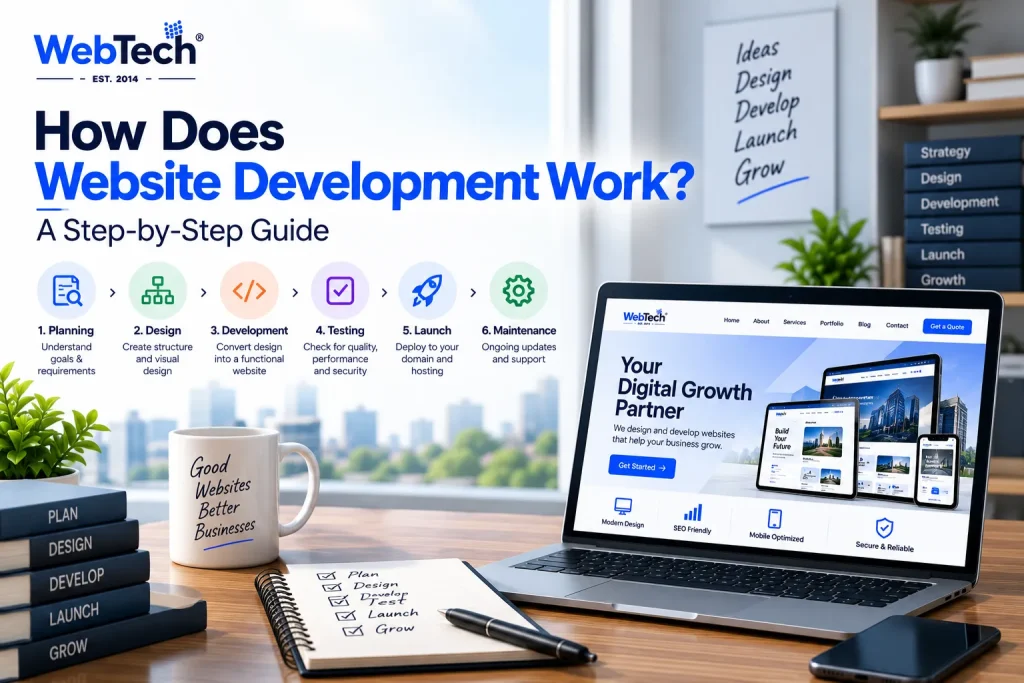
Website development works through a structured process of planning, design, coding, testing, and launching a website. It also includes content integration, SEO, security, performance optimization, and ongoing maintenance.
A website may look simple when you visit it, but creating a professional website involves several stages, from planning and design to development, testing, launch, and ongoing maintenance.
So, how does website development work?
Website development is the process of planning, designing, building, testing, launching, and maintaining a website. Depending on the project’s goals, developers may use technologies such as HTML, CSS, JavaScript, PHP, databases, APIs, content management systems, or modern web frameworks.
For a business website, the process usually starts with understanding the business and its customers. The development team then creates the website structure, designs the user interface, develops the required functionality, adds content, tests the website, and finally publishes it online.
This guide explains the website development process step by step, including what happens before, during, and after a website goes live.
What Is Website Development?
Website development is the technical process of creating and maintaining a website.
It includes everything required to turn a website idea into a working online platform.
Depending on the project, website development may involve:
- Website planning
- Domain and hosting setup
- Information architecture
- UI/UX design
- Front-end development
- Back-end development
- Database development
- Content management systems
- API integration
- Payment gateway integration
- Security configuration
- Search engine optimization
- Performance optimization
- Testing
- Deployment
- Website maintenance
Website development can range from a simple business website with a few pages to a complex eCommerce platform, web application, or custom software system.
How Does Website Development Work?
A professional website development project generally follows a series of connected stages.
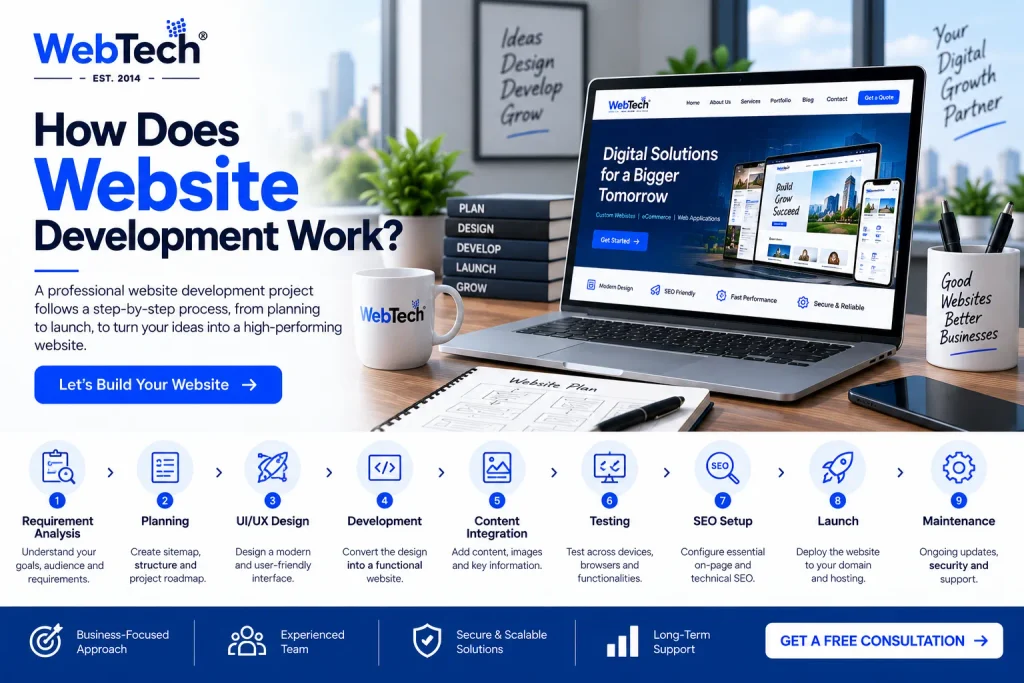
The exact process varies depending on the website type, but the main steps are:
- Requirement analysis
- Website planning
- Sitemap and information architecture
- UI/UX design
- Front-end development
- Back-end development
- Database and functionality development
- Content integration
- SEO implementation
- Testing and quality assurance
- Deployment
- Maintenance and optimization
Let’s look at each stage in detail.
1. Requirement Analysis
The first stage is understanding what the website needs to accomplish.
Before writing code or designing pages, the development team needs to understand the business, target audience, products or services, competitors, and project objectives.
Important questions may include:
- What is the purpose of the website?
- Who will use it?
- What products or services will be promoted?
- How many pages are required?
- Does the website need eCommerce functionality?
- Will users need to create accounts?
- Is online payment required?
- Does the website need a booking system?
- Are third-party APIs required?
- What content already exists?
- What are the SEO requirements?
For example, a local service business may need a lead-generation website, while an online retailer may need product catalogs, shopping carts, payment processing, order management, and customer accounts.
A clear requirements document helps prevent unnecessary changes later in the project.
2. Website Planning
Once the requirements are understood, the next step is planning the website.
Planning determines how the website will be structured and how users will move through it.
A typical business website might include:
- Home
- About Us
- Services
- Individual Service Pages
- Portfolio
- Blog
- Contact
- Privacy Policy
- Terms and Conditions
An eCommerce website may require additional sections such as:
- Shop
- Product Categories
- Product Pages
- Cart
- Checkout
- My Account
- Order Tracking
At this stage, the development team may also decide which platform and technologies are appropriate for the project.
3. Sitemap and Information Architecture
A sitemap defines the relationship between different pages on a website.
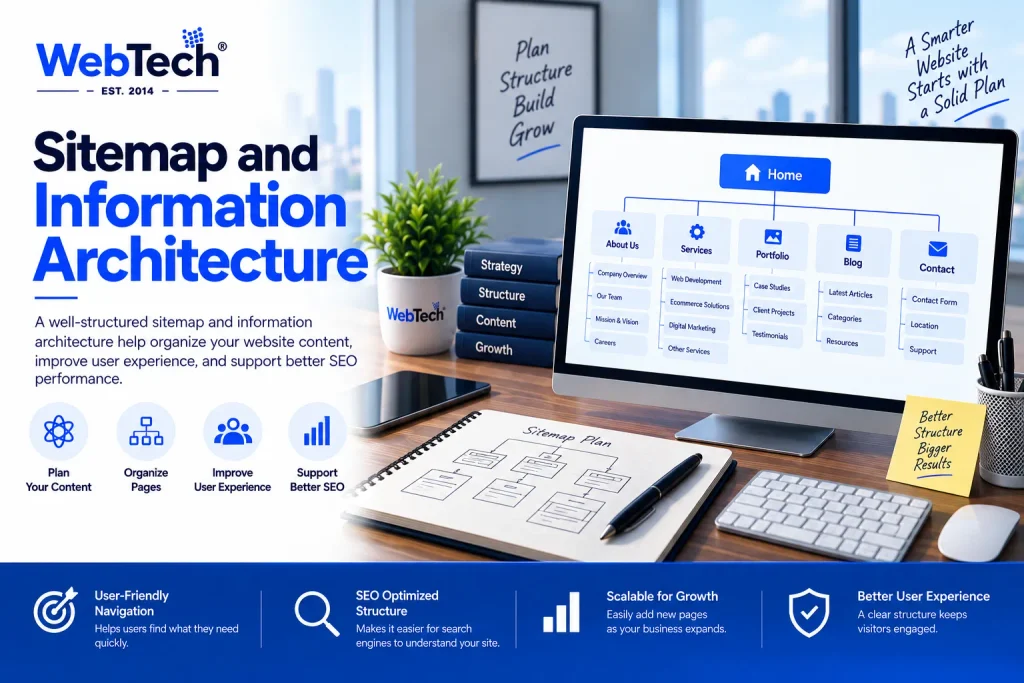
For example:
Home
→ Services
→ Website Development
→ eCommerce Development
→ Digital Marketing
Home
→ About
→ Portfolio
→ Blog
→ Contact
Good information architecture makes it easier for users and search engines to understand the website.
It also helps establish a logical internal linking structure.
For SEO-focused websites, the sitemap should be planned around search intent and topic relationships rather than simply listing pages.
4. UI/UX Design
After planning, the visual and user experience aspects of the website are designed.
UI stands for User Interface.
UX stands for User Experience.
UI focuses on how the website looks, while UX focuses on how it works and how easily users can complete tasks.
Design decisions may include:
- Page layouts
- Navigation
- Typography
- Buttons
- Forms
- Images
- Colors
- Mobile layouts
- Calls to action
- Product displays
- Contact sections
The goal is not simply to make a website attractive.
A good website should make it easy for visitors to find information and take the intended action.
For example, a service website may want visitors to:
Visit → Understand the service → Trust the business → Request a quote
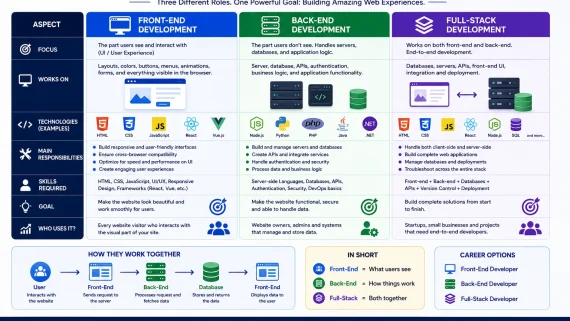
5. Front-End Development
The front end is the part of the website that users see and interact with.
Common front-end technologies include:
- HTML
- CSS
- JavaScript
Modern projects may also use frameworks and libraries depending on their requirements.
Front-end development converts the approved design into a functional web interface.
Developers build elements such as:
- Navigation menus
- Buttons
- Forms
- Sliders
- Cards
- Product sections
- Responsive layouts
- Interactive components
The website also needs to work properly across different screen sizes.
6. Responsive Web Development
Most websites need to work across multiple devices, including:
- Desktop computers
- Laptops
- Tablets
- Smartphones
Responsive web development allows the layout to adapt to different screen sizes.
For example, a desktop website might display four product cards in a row, while the same content could appear as one or two cards per row on a smartphone.
A responsive website should also provide:
- Readable text
- Easy navigation
- Properly sized buttons
- Usable forms
- Optimized images
- Fast loading
- No unnecessary horizontal scrolling
Mobile usability is particularly important because a significant portion of website traffic comes from mobile devices.
7. Back-End Development
The back end handles the server-side functionality of a website.
Users may not directly see the back-end code, but it powers many functions behind the interface.
Back-end development can manage:
- User accounts
- Authentication
- Orders
- Product information
- Contact forms
- Databases
- Payments
- Booking systems
- Admin dashboards
- APIs
- Business logic
For example, when a customer places an order on an eCommerce website, the front end collects the customer’s information, while the back end processes the order and stores the relevant data.
8. Database Development
Websites that need to store and retrieve information may use a database.
A database can store information such as:
- Customer accounts
- Products
- Orders
- Blog posts
- Contact submissions
- Inventory
- Booking information
- Website settings
The database structure depends on the type of website being developed.
A simple business website may require very little custom database functionality, while an eCommerce platform or web application may require a more complex database architecture.
9. Content Integration
Once the website structure and functionality are ready, content is added.
Website content may include:
- Page copy
- Product descriptions
- Images
- Videos
- Blog articles
- Service information
- FAQs
- Testimonials
- Contact information
Content should be written for both users and search engines.
Important considerations include:
- Search intent
- Keyword relevance
- Readability
- Content structure
- Headings
- Internal links
- Metadata
- Image optimization
- Conversion-focused calls to action
For an SEO-focused website, content planning should ideally begin before development is finished.
10. SEO Implementation
Search engine optimization should not be treated as something that happens only after a website is launched.
Technical and on-page SEO can be considered during development.
Important areas include:
Technical SEO
- Crawlability
- Indexability
- Site structure
- URL structure
- XML sitemap
- Robots.txt
- Canonical URLs
- Page speed
- Mobile usability
- HTTPS
- Structured data
On-Page SEO
- Page titles
- Meta descriptions
- H1-H6 structure
- Search intent
- Keyword targeting
- Internal linking
- Image alt text
- Content quality
Local SEO
For businesses targeting specific locations, the website may also need location-focused pages and business information.
11. Website Testing
Before launch, the website needs to be tested.
Testing helps identify technical, usability, design, and content problems.
Common testing areas include:
- Desktop compatibility
- Mobile compatibility
- Browser compatibility
- Navigation
- Contact forms
- Buttons
- Links
- Search functionality
- Login systems
- Checkout
- Payment systems
- Page speed
- Security
- SEO elements
For an eCommerce website, the checkout process should be tested carefully from product selection through order confirmation.
A website should not be considered ready simply because the pages look correct.
The functionality also needs to work correctly.
12. Website Deployment
After testing and approval, the website can be deployed to the live server.
Deployment generally involves:
- Connecting the domain
- Configuring hosting
- Uploading website files
- Setting up databases
- Configuring SSL
- Connecting required services
- Checking DNS settings
- Configuring email if necessary
- Testing the live environment
Once deployment is complete, the website becomes accessible to visitors through its domain name.
For example:
example.com
The launch process should also include a final review of important pages, forms, links, indexing settings, and analytics.
13. Website Maintenance
Website development does not necessarily end when the website goes live.
Websites require ongoing maintenance to remain secure, functional, and up to date.
Maintenance may include:
- Software updates
- Security monitoring
- Backups
- Bug fixes
- Content updates
- Performance optimization
- SEO improvements
- Plugin updates
- Database maintenance
- Technical troubleshooting
For websites that generate leads or sales, regular monitoring is especially important because technical problems can directly affect business performance.
How Long Does Website Development Take?
The development timeline depends on the type and complexity of the website.
A basic business website may take considerably less time than a large eCommerce website or custom web application.
Factors that influence development time include:
- Number of pages
- Design complexity
- Content availability
- Custom functionality
- eCommerce requirements
- API integrations
- Payment gateways
- Database requirements
- Revision rounds
- Client approvals
- SEO requirements
A website project should therefore be estimated based on its actual scope rather than using one fixed timeline for every project.
How Much Does Website Development Cost in Bangladesh?
The cost of website development in Bangladesh varies significantly depending on the website’s requirements.
A simple informational website generally costs less than a custom eCommerce platform or web application.
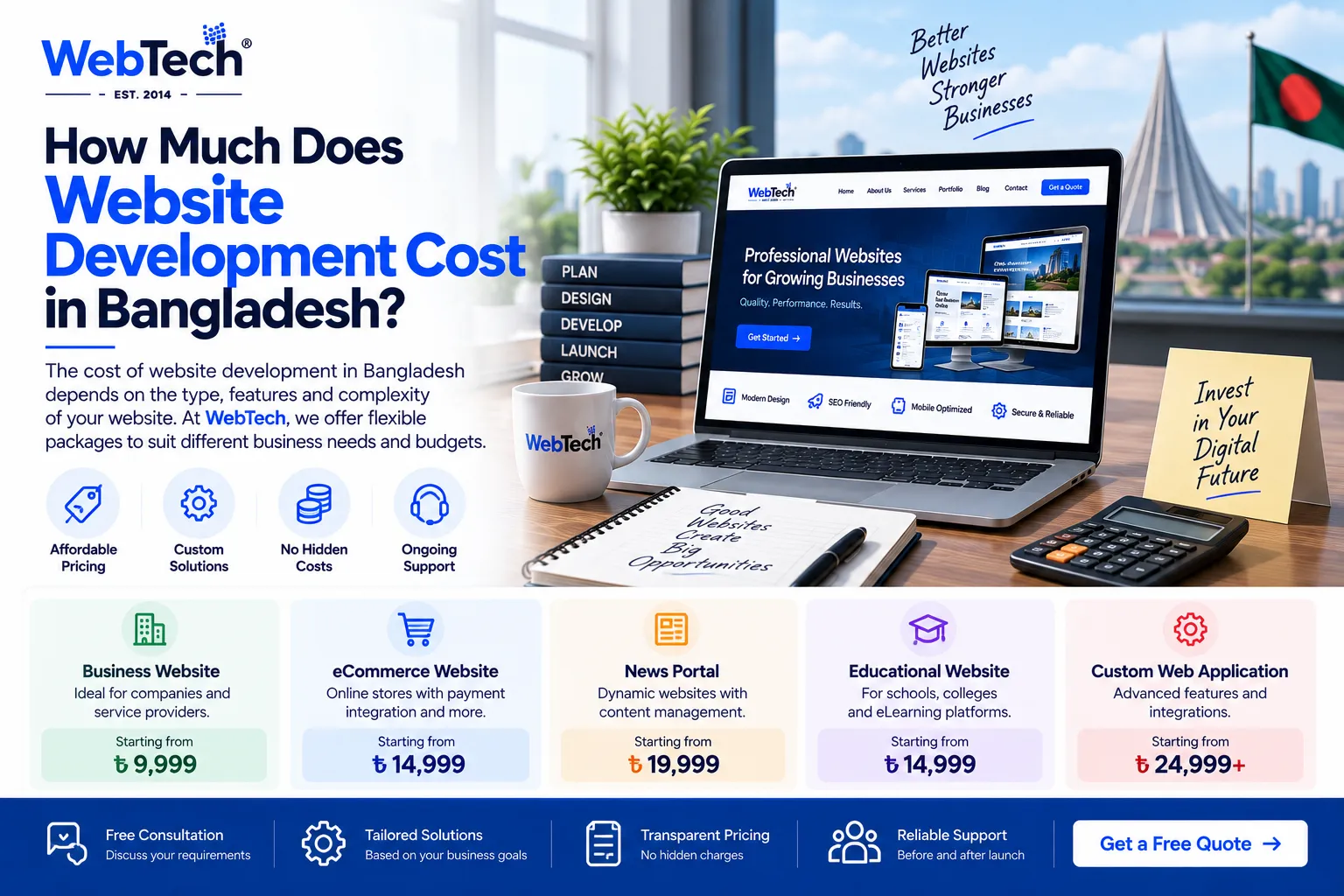
Factors affecting website development cost include:
- Website type
- Number of pages
- Design requirements
- CMS or technology stack
- Custom development
- eCommerce functionality
- Payment integration
- API integration
- Hosting
- Domain
- Content creation
- SEO
- Maintenance
For an accurate quotation, a development company should first understand the website requirements.
Website Development vs. Web Design
Website design and website development are related but different.
Web design focuses primarily on the visual interface and user experience.
Web development focuses on building the functionality that makes the website work.
For example:
Design:
A designer creates the layout of a product page.
Development:
A developer builds the product page so that product information, pricing, images, inventory, cart functionality, and other required features work correctly.
Professional website projects generally require both design and development.
Website Development vs. Website Building Platforms
There are several ways to create a website.
CMS-Based Development
A content management system can allow businesses to manage website content without editing code directly.
This can be suitable for:
- Business websites
- Blogs
- Service websites
- Content-heavy websites
- Many eCommerce projects
Custom Development
Custom development provides greater control over functionality and architecture.
It may be appropriate for:
- Web applications
- Complex business systems
- Custom marketplaces
- Advanced dashboards
- Specialized platforms
- Projects requiring unique functionality
The right approach depends on the business requirements, budget, scalability needs, and technical complexity.
What Is Needed to Develop a Website?
Before development begins, it is useful to prepare:
- Business information
- Domain name
- Hosting
- Logo
- Brand assets
- Website content
- Images
- Service or product information
- Contact details
- Target locations
- Competitor examples
- Functional requirements
- SEO requirements
For custom projects, a detailed requirements document can make the development process much more efficient.
What Happens After a Website Goes Live?
Launching a website is only the beginning of its online presence.
After launch, businesses should monitor:
- Website traffic
- Search performance
- Leads
- Conversion rates
- User behavior
- Page speed
- Technical errors
- Search indexing
- Security
Analytics and search data can reveal which pages perform well and where improvements are needed.
The website can then be continuously improved based on actual user behavior and business objectives.
Why Is Professional Website Development Important?
A professional website is more than an online brochure.
For many businesses, the website serves as:
- A sales channel
- A lead-generation platform
- A product catalog
- A customer information resource
- A brand asset
- A communication channel
- An SEO platform
Poor development can create problems such as:
- Slow loading
- Poor mobile usability
- Broken functionality
- Security vulnerabilities
- Difficult navigation
- Weak SEO performance
- Poor conversion rates
Professional development helps create a stronger technical foundation for long-term growth.
Website Development Process at WebTech
At WebTech, we approach website development as a structured process rather than simply creating pages.
Our process can include:
1. Discovery
Understand the business, audience, objectives, and requirements.
2. Planning
Create the website structure, page hierarchy, functionality requirements, and development plan.
3. Design
Develop the visual interface and user experience.
4. Development
Build the front-end, back-end, CMS, database, integrations, and required functionality.
5. Content & SEO
Integrate content and implement relevant technical and on-page SEO elements.
6. Testing
Check usability, functionality, responsiveness, performance, and technical elements.
7. Launch
Deploy the website to the production environment.
8. Maintenance
Continue improving, updating, securing, and optimizing the website as required.
Need Professional Website Development in Bangladesh?
A successful website starts with the right development process.
Whether you need a business website, eCommerce website, corporate website, service website, or custom web solution, the development approach should be based on your business goals and technical requirements.
WebTech provides custom website development services in Bangladesh with a focus on responsive design, functionality, usability, SEO foundations, and business objectives.
If you are planning a new website or want to improve an existing one, contact WebTech to discuss your requirements.
Ready to build your website? Contact WebTech for a website development consultation.
Frequently Asked Questions
How does website development work?
Website development works through a series of stages including requirement analysis, planning, design, front-end development, back-end development, content integration, SEO, testing, deployment, and maintenance.
What are the main steps in website development?
The main steps are requirement analysis, planning, sitemap development, UI/UX design, development, content integration, SEO, testing, deployment, and ongoing maintenance.
How long does website development take?
The development timeline depends on the website’s size, design complexity, functionality, content, integrations, revisions, and client requirements. A simple business website generally requires less development time than a custom web application.
How much does website development cost in Bangladesh?
Website development costs in Bangladesh vary according to the website type, number of pages, design, functionality, technology, integrations, content, SEO requirements, hosting, and maintenance.
What is the difference between web design and web development?
Web design focuses primarily on the visual appearance and user experience of a website, while web development focuses on building the technical functionality that makes the website work.
Is website development important for SEO?
Yes. Website development affects important SEO factors such as site structure, crawlability, page speed, mobile usability, URLs, technical performance, structured data, and indexability.
Can a website be developed for mobile devices?
Yes. Responsive website development allows a website to adapt to smartphones, tablets, laptops, and desktop computers.
Does website development include SEO?
SEO can be incorporated into the development process through technical SEO, site architecture, URL structure, metadata, content structure, performance optimization, internal linking, and structured data.
Do websites need maintenance after development?
Yes. Regular maintenance can help keep websites secure, updated, functional, and optimized. Maintenance may include software updates, backups, security checks, bug fixes, content updates, and performance improvements.
Can WebTech develop an eCommerce website?
Yes. WebTech can develop eCommerce websites with features such as product catalogs, shopping carts, checkout, payment integration, order management, and other requirements depending on the project.
Can WebTech develop a custom website?
Yes. Custom website development can be used when a business requires functionality or workflows that cannot be adequately addressed by a standard website setup.
Conclusion
Website development is a complete process that combines planning, design, programming, content, SEO, testing, deployment, and maintenance.
Understanding how website development works helps businesses make better decisions about their website requirements, budget, technology, and long-term strategy.
The most effective website is not necessarily the one with the most features. It is the one that combines appropriate technology, useful content, good user experience, strong performance, and functionality that supports the business objective.
If you are planning a new website in Bangladesh, start by clearly defining what the website needs to achieve. From there, the right development process can turn that objective into a functional and scalable online presence.






Comments
Comments are closed.