

Local Keyword Research: How to Find the Right Keywords
Local Keyword Research: How to Find the Right Keywords for Your Business
Local keyword research is the process of finding the words and phrases people use when searching for a business, product, or service in a particular area.
For example, someone looking for a dentist may search for “dentist in Dhaka,” “dentist in Gulshan,” or simply “dentist near me.” These searches tell us that the person is looking for a local service, not general information about dentistry.
For businesses that depend on customers from a specific city, neighborhood, or service area, choosing the right local keywords can make the website and Google Business Profile more relevant to local searches.
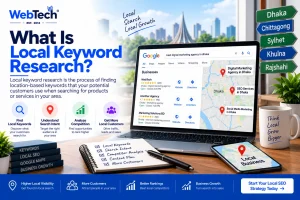
Local keyword research is the process of finding search terms people use to discover businesses, products, or services in a specific location. It helps businesses target relevant local searches such as service + location, neighborhood, location-based, and “near me” queries.
What Is Local Keyword Research?
Local keyword research involves identifying search terms that have a local intent.
The location may be explicitly included in the search, or it may be understood from the context of the search.
For example:
- SEO company in Dhaka
- Web design company Bangladesh
- Restaurant in Dhanmondi
- Pest control service in Uttara
- Dentist near me
- Best coffee shop near me
The important part is understanding what the searcher wants and where they want the service.
Local keyword research helps a business identify these patterns and decide which keywords should be used across its website, Google Business Profile, service pages, location pages, and other relevant online properties.
eCommerce Website Cost in Bangladesh
Why Do Local Keywords Matter?
People searching locally are often looking for something they can use, visit, buy, or contact.
Someone searching for “pest control service in Dhaka” is likely to have a different intent from someone searching for “what is pest control?”
The first search has a strong commercial and local intent.
That difference matters.
Using relevant local keywords can help a business:
- Reach customers in its target area
- Improve local search relevance
- Build better service pages
- Support Google Maps visibility
- Attract more qualified website visitors
- Create location-specific content
- Connect services with local search demand
However, simply adding a city name to every page is not a local SEO strategy. The keyword needs to make sense within the content and match the service being offered.
Types of Local Keywords
Local searches can take several forms. Understanding the differences makes keyword research much more useful.
Location-Based Keywords
These keywords include a specific location.
Examples:
- SEO services Dhaka
- Web development Bangladesh
- Restaurant Dhanmondi
- Pest control Uttara
- Digital marketing agency Dhaka
The location can be a:
- Country
- City
- District
- Neighborhood
- Area
- Service region
The right geographic level depends on where the business actually operates.
Service + Location Keywords
This is one of the most useful local keyword patterns for service businesses.
The basic formula is:
Service + Location
Examples:
- Local SEO services in Dhaka
- Website development Bangladesh
- AC repair Uttara
- Pest control Dhaka
- Interior design Gulshan
You can also find variations such as:
Location + Service
For example:
- Dhaka SEO company
- Bangladesh web development company
- Uttara pest control
Both versions can represent the same general intent, but search behavior and competition can differ.
“Near Me” Searches
“Near me” searches are another important part of local search.
Examples include:
- SEO company near me
- Restaurant near me
- Dentist near me
- Car repair near me
- Coffee shop near me
The phrase “near me” does not necessarily mean a business should put “near me” repeatedly on its website.
Google can use the searcher’s location and other local signals to determine which businesses are relevant.
Instead of keyword stuffing, businesses should focus on providing accurate business information, a strong Google Business Profile, relevant website content, and genuine local relevance.
Neighborhood-Based Keywords
Some businesses serve specific neighborhoods rather than an entire city.
For example, a business operating in Dhaka might target relevant areas such as:
- Gulshan
- Banani
- Dhanmondi
- Uttara
- Mirpur
- Mohammadpur
- Badda
- Motijheel
A location keyword is useful when the business genuinely serves customers in that area.
Creating a separate page for every neighborhood without unique, useful information can create thin or repetitive content. Location pages should exist for a real business reason.
Local Intent Keywords
Not every local keyword contains a location name.
A search such as:
could have local intent depending on the searcher’s location and search context.
Other examples include:
- Best restaurant nearby
- Emergency plumber
- Open dentist
- Local web designer
- SEO agency near me
This is why local keyword research should consider search intent, not just keywords containing city names.
How Local Keywords Are Used in Website SEO
Once local keywords have been identified, they need to be mapped to appropriate pages.
For example:
| Search Intent | Example Keyword | Suitable Page |
|---|---|---|
| Service + location | SEO services in Dhaka | SEO service page |
| Service + country | Website development Bangladesh | Website development page |
| Local service | Pest control Dhaka | Pest control service page |
| Informational | How does local SEO work? | Blog/article |
| Pricing | SEO services price Bangladesh | Pricing page |
| Brand/location | WebTech Dhaka | Homepage/about/contact |
This approach prevents one page from trying to rank for every local keyword.
A service page should primarily explain the service.
An informational article should answer the user’s question.
A pricing page should address cost and packages.
Matching the keyword to the correct page is one of the most important parts of local SEO.
How Local Keywords Support Google Business Profile
Local keyword research is not limited to your website.
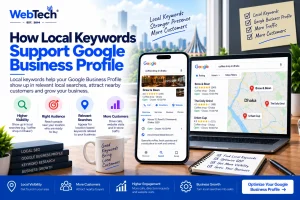
It can also help you understand how people search for the services listed on your Google Business Profile.
For example, if your business provides website development and SEO, your research may reveal searches related to:
- Website development company
- Web design company
- SEO services
- Local SEO services
- eCommerce website development
These insights can help you organize relevant services and describe your business more clearly.
However, businesses should avoid artificially inserting keywords into the business name or creating misleading information.
Your business name, category, services, address or service area, and other profile information should accurately represent the real business.
Local Keyword Research Process
A useful local keyword research process does not have to be complicated.
1. List Your Core Services
Start with the services or products your business actually provides.
For example, a digital agency might offer:
- Website development
- eCommerce development
- SEO
- Local SEO
- Google Maps SEO
- Web design
These become the starting points for keyword research.
2. Define Your Target Locations
Next, identify the areas where you genuinely want customers.
Depending on the business, this could be:
- Bangladesh
- Dhaka
- Chattogram
- Sylhet
- A specific district
- Specific neighborhoods
- A defined service area
Do not target locations simply because they have search volume.
The business should actually be able to serve customers there.
3. Combine Services With Locations
Create combinations of your core services and target locations.
For example:
SEO + Dhaka
→ SEO services Dhaka
→ SEO company Dhaka
→ SEO agency Dhaka
Website Development + Bangladesh
→ Website development Bangladesh
→ Website development company Bangladesh
→ Web design company Bangladesh
These combinations provide a starting keyword list.
4. Look for Keyword Variations
People rarely use exactly the same wording.
A customer might search:
- SEO company Dhaka
- SEO agency Dhaka
- SEO services Dhaka
- SEO expert Dhaka
These searches may overlap, but they should not automatically become four separate pages.
First understand whether they represent substantially different intent.
If the intent is essentially the same, one strong page may be better than several weak pages.
5. Analyze Search Intent
For every important keyword, ask:
What does the person expect to find?
For example:
“How does local SEO work?”
→ Informational article
“Local SEO services Bangladesh”
→ Service page
“Local SEO price Bangladesh”
→ Pricing page
“Google Maps SEO”
→ Dedicated service or informational page
This prevents a common SEO mistake: creating a page simply because a keyword exists without considering what the searcher actually needs.
6. Review Competitor Search Results
Search your important local terms and examine the pages that appear.
Look at:
- Page titles
- H1 headings
- Services covered
- Location relevance
- Content depth
- Internal links
- Business information
- Search intent
- Local signals
The purpose is not to copy competitors.
Instead, identify what users are being shown and determine whether your own page can provide a clearer or more useful answer.
7. Group Related Keywords
Once you have a keyword list, group similar terms by topic and intent.
For example:
Main Topic: Local SEO
- local SEO services
- local SEO company
- local SEO agency
- local SEO services Bangladesh
These may belong to one commercial service page.
Main Topic: Local SEO Education
- what is local SEO
- how does local SEO work
- how to improve local SEO
These may be better suited to supporting articles.
Keyword grouping helps prevent unnecessary pages and creates a cleaner website architecture.
8. Map Keywords to Pages
Finally, assign each important keyword group to the page that best satisfies its intent.
A simple structure could look like:
Local SEO Service Page
→ Local SEO services
→ Local SEO company
→ Local SEO Bangladesh
Google Maps SEO Page
→ Google Maps SEO
→ Google Maps ranking
→ Maps SEO services
Supporting Article
→ Local keyword research
→ How local keywords work
→ Local SEO keyword strategy
This creates a clear relationship between commercial pages and supporting content.
Common Local SEO Keyword Mistakes
Keyword Stuffing
Repeating a city or service keyword unnaturally does not make a page more relevant.
For example:
“We provide SEO services Dhaka for SEO companies Dhaka and SEO agency Dhaka businesses in Dhaka.”
This is difficult to read and provides little value.
Write naturally and use keywords where they genuinely fit.
Creating Too Many Location Pages
Creating dozens of nearly identical pages for different neighborhoods can create thin content.
A location page should provide meaningful information about that location and the service being offered.
If there is nothing useful to say, a separate page may not be necessary.
Targeting Locations You Do Not Serve
Do not create pages for cities or areas simply because you want their traffic.
If the business does not serve a location, targeting it can create a poor user experience and misleading information.
Ignoring Search Intent
A keyword may look valuable but still be wrong for a particular page.
For example, an informational keyword should not lead to a page that immediately pushes a sales message without answering the question.
The content should match what the searcher is trying to accomplish.
Focusing Only on Search Volume
Search volume is useful, but it is not the only consideration.
A lower-volume keyword with strong commercial intent can be more valuable to a local business than a broad keyword with a much larger audience.
For example:
“SEO”
is extremely broad.
“local SEO services in Dhaka”
is much more specific and may be closer to a buying decision.
How Local Keywords Support Google Maps SEO
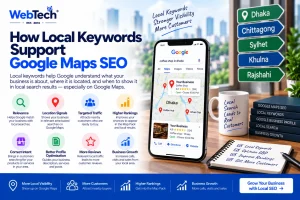
Google Maps visibility depends on more than keywords.
Local relevance can be supported by several signals, including:
- Accurate business information
- Relevant business category
- Complete Google Business Profile
- Relevant services
- Customer reviews
- Website relevance
- Local prominence
- Consistent business information
- Geographic relevance
Local keyword research helps identify the language customers use, but those terms should be used naturally across the relevant online presence.
For businesses targeting local customers, Google Maps SEO and website SEO can work together rather than being treated as completely separate strategies.
Local Keyword Research for Different Businesses
The right keyword strategy depends on the business model.
Local Service Businesses
Examples include:
- Plumbers
- Electricians
- Pest control companies
- Dentists
- Lawyers
- Cleaning services
- Repair businesses
These businesses often benefit from service + location keywords.
Restaurants
Restaurants may target searches related to:
- Cuisine
- Restaurant type
- Neighborhood
- Dining experience
- Location
For example:
“Indian restaurant in Dhanmondi”
has a very different intent from:
“best Indian recipes.”
The first is local and transactional. The second is informational.
eCommerce Businesses
An online store may target national or broader searches rather than only local keywords.
However, local terms can still matter if the business offers:
- Same-day delivery
- Local delivery
- Physical stores
- City-specific services
- Pickup
- Regional products
The strategy should reflect how the business actually operates.
Local SEO Strategy for Your Business
Local keyword research is one part of a larger local SEO strategy.
A complete approach may include:
Local Keyword Research
↓
Website & Content Optimization
↓
Google Business Profile Optimization
↓
Google Maps SEO
↓
Reviews & Local Reputation
↓
Citations & Business Information
↓
Local Authority
↓
Local Visibility & Qualified Leads
The objective is not simply to rank for a list of keywords.
The real goal is to make your business easier to discover when potential customers are looking for what you offer.
Why Local Keyword Research Matters for WebTech
For businesses targeting customers in Bangladesh, local search can be an important source of qualified traffic.
WebTech can use local keyword research to understand:
- What customers are searching for
- Which services have local demand
- Which locations matter
- What search intent sits behind each query
- Which pages should target which topics
- How website content can support local visibility
This information can then contribute to a broader local SEO strategy rather than being treated as an isolated keyword exercise.
Get Local SEO Support
Finding local keywords is only the first step.
Those keywords need to be connected to the right pages, useful content, accurate business information, Google Business Profile optimization, and a broader local SEO strategy.
If your business wants to improve its visibility in local search, WebTech provides local SEO services focused on website optimization, local relevance, Google Business Profile, Google Maps SEO, content, and other relevant local search factors.
Contact WebTech to discuss your local SEO requirements and target locations.
Frequently Asked Questions
What is local keyword research?
Local keyword research is the process of finding search terms people use to discover businesses, products, or services in a specific geographic area.
What are local SEO keywords?
Local SEO keywords are search terms that indicate local intent, such as service + location phrases, neighborhood searches, location-based terms, and relevant “near me” searches.
How do I find local keywords for my business?
Start by listing your main services and target locations, then combine them into relevant search terms. Analyze search intent, review search results and competitors, identify keyword variations, group related terms, and map each group to the most appropriate website page.
Should I use “near me” as a keyword?
You do not need to repeatedly add “near me” to your website content. Search engines can use the searcher’s location and other local signals to understand geographic relevance. Focus instead on accurate business information and genuinely useful local content.
Are location-based keywords important for local SEO?
They can be important because they help communicate geographic relevance. However, location keywords should reflect areas the business genuinely serves and should be used naturally.
How do local keywords help Google Maps SEO?
Local keyword research helps businesses understand the language customers use when searching locally. Those insights can support relevant website content, services, Google Business Profile optimization, and broader local SEO efforts.
How many local keywords should a business target?
There is no universal number. A better approach is to target relevant keyword groups based on services, locations, search intent, competition, and business priorities rather than trying to target as many keywords as possible.
Can one page target multiple local keywords?
Yes, when the keywords have closely related search intent. A strong page can naturally cover several variations of the same topic without creating separate pages for every keyword variation.
Should I create a page for every city or neighborhood?
Not necessarily. A location page should exist when the business genuinely serves that area and there is enough useful, unique information to provide. Creating large numbers of nearly identical location pages can result in poor-quality content.
Conclusion
Local keyword research helps businesses understand what people search for, where they are searching from, and what they want to find.
The strongest local SEO strategies do not rely on adding city names everywhere. They connect relevant services, locations, search intent, useful content, website structure, Google Business Profile optimization, and other local signals.
Start with the services your business actually provides, identify the locations you genuinely serve, research how customers search, and then build pages that give those users a useful reason to choose your business.
Local keywords are the starting point. Relevance, useful content, strong website structure, and genuine local presence turn that research into an effective local SEO strategy.

Comments
Comments are closed.