
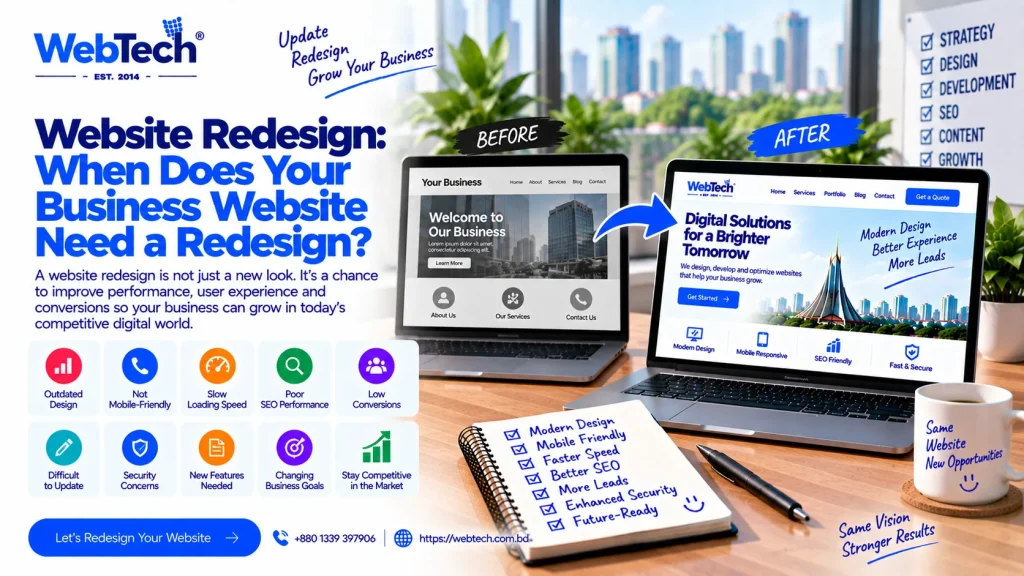
Website Redesign: When Does Your Business Website Need a Redesign?
What is website redesign?
Website redesign is the process of improving an existing website’s design, structure, content, user experience, performance, mobile responsiveness, SEO, and technical functionality. A redesign can help a business modernize its website and better meet current customer and business requirements.
Website Redesign: When Does Your Business Website Need a Redesign?
A business website can look fine when it is first launched, but that does not mean it will continue to meet your business needs for years.
Design trends change. Customers use different devices. Search engines evolve. New business goals require new features. Even a website that once generated regular leads can gradually become difficult to use, slow, outdated, or difficult to maintain.
That is where website redesign becomes important.
Website redesign is not simply about changing colors, fonts, or adding a new homepage. A proper redesign looks at the website as a whole, including its design, user experience, mobile responsiveness, content, SEO, performance, security, navigation, and conversion paths.
For some businesses, redesigning an existing website can be more practical than building an entirely new website. However, the right approach depends on the website’s current technology, structure, content, performance, and business requirements.
What Is Website Redesign?
Website redesign is the process of improving an existing website’s design, structure, content, user experience, performance, mobile responsiveness, SEO, and technical functionality.
A redesign may involve small improvements or a complete transformation of an existing website.
For example, a business may redesign its website to:
- Modernize the visual design
- Improve mobile responsiveness
- Make navigation easier
- Improve page speed
- Improve SEO structure
- Increase inquiries and leads
- Add new services or features
- Improve website security
- Update outdated content
- Improve the overall user experience
A website redesign does not always mean starting from zero. Depending on the condition of the existing website, some elements can be retained while others are rebuilt or improved.
Why Do Businesses Redesign Their Websites?
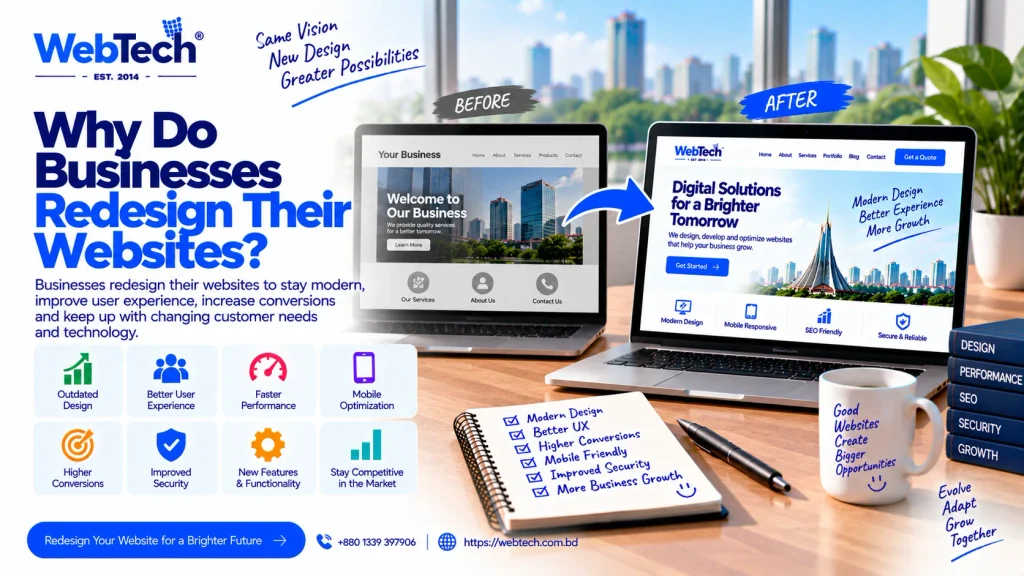
Your website represents your business online. If the website is difficult to use, outdated, slow, or unclear, visitors may leave before understanding what your business offers.
Businesses commonly consider a website redesign when their existing website no longer supports their current goals.
Some common reasons include:
website development cost in Bangladesh
1. The Website Looks Outdated
Website design standards change over time.
A website that looked modern several years ago may now appear outdated because of:
- Old layouts
- Crowded pages
- Poor typography
- Outdated graphics
- Inconsistent colors
- Excessive animations
- Poor spacing
- Complicated navigation
A redesign can create a cleaner and more consistent visual experience.
2. The Website Is Not Mobile-Friendly
Many people access websites using smartphones.
If your website does not display properly on smaller screens, users may have difficulty:
- Reading content
- Clicking buttons
- Filling out forms
- Viewing images
- Navigating menus
- Finding contact information
A responsive redesign can make the website easier to use across smartphones, tablets, laptops, and desktop computers.
3. Your Website Is Slow
Website performance can affect the user experience.
Slow pages can be caused by:
- Large images
- Poor hosting
- Excessive plugins
- Unoptimized code
- Third-party scripts
- Poorly configured caching
- Outdated website technology
A redesign can provide an opportunity to review the website’s technical structure and improve performance.
However, not every speed problem requires a complete redesign. Sometimes optimization of the existing website is enough.
4. Navigation Is Difficult
Visitors should be able to understand where to go next.
If users have to search through multiple pages to find a service, contact information, pricing information, or important content, the website may need structural improvements.
A good redesign should consider:
- Main navigation
- Page hierarchy
- Internal links
- Service categories
- Breadcrumbs
- Calls to action
- Footer navigation
- Search functionality where appropriate
The goal is to make important information easier to discover.
5. Your Website Is Not Generating Enough Leads
A website can receive visitors without generating meaningful inquiries.
Sometimes the problem is not traffic. It may be the website experience.
For example, visitors may not clearly understand:
- What the company offers
- Who the service is for
- Why they should choose the business
- How much information they need to provide
- How to contact the company
- What action they should take next
A redesign can improve the conversion path by making important information and calls to action easier to find.
6. Your Business Has Changed
Businesses evolve.
You may have:
- Added new services
- Entered new markets
- Changed your branding
- Added new locations
- Started offering eCommerce
- Changed your target customers
- Expanded your team
- Added new business divisions
If the website still reflects your old business model, a redesign may be necessary.
Your website should accurately represent what your business currently does.
Signs Your Website Needs a Redesign
Not every old website needs a complete redesign. However, several warning signs can indicate that it is time to review the website.
Common signs include:
- The website looks outdated
- The website is difficult to use on mobile devices
- Pages load slowly
- Navigation is confusing
- Content is outdated
- Important services are difficult to find
- The website generates few inquiries
- Forms do not work properly
- The website has technical errors
- The CMS or plugins are outdated
- The website is difficult to maintain
- The design is inconsistent
- The website has poor SEO structure
- Important pages are missing
- The website does not reflect the current brand
- Customers frequently ask questions that the website should answer
If several of these problems exist at the same time, a website audit can help determine whether optimization or redesign is the more appropriate solution.
Website Redesign vs. Building a New Website
One of the most common questions businesses ask is whether they should redesign their existing website or build a completely new one.
There is no single answer for every business.
Website Redesign
A redesign may be suitable when:
- The existing platform is still reliable
- The website has valuable content
- Existing URLs have SEO value
- The current database can be retained
- The website structure can be improved
- The existing technology supports the required features
New Website Development
A new website may be more appropriate when:
- The current technology is severely outdated
- The website has major technical limitations
- The CMS is no longer suitable
- The existing codebase is difficult to maintain
- The website architecture needs to be completely changed
- New functionality cannot reasonably be added to the existing system
Before deciding, businesses should evaluate the existing website rather than choosing based only on appearance.
What Does a Website Redesign Include?
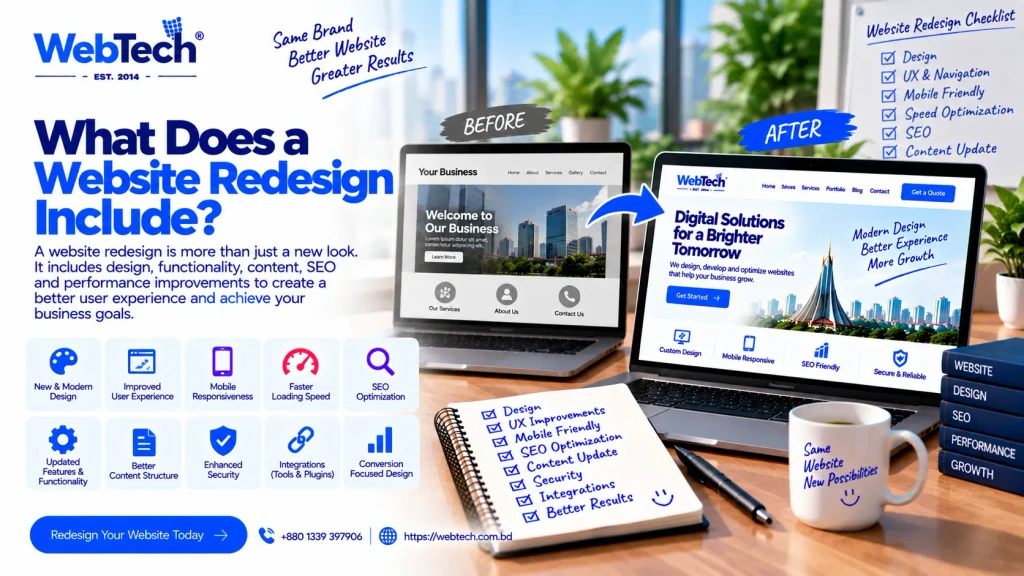
A professional website redesign can involve several areas.
how to choose a website development company in Bangladesh
Design Improvement
The visual design may be updated to create a more modern and consistent appearance.
This can include:
- Typography
- Colors
- Layout
- Images
- Buttons
- Icons
- Section spacing
- Header and footer
- Navigation
- Brand consistency
User Experience Improvement
The redesign should consider how visitors interact with the website.
A better UX can make it easier for users to:
- Find information
- Understand services
- Compare options
- Contact the business
- Complete forms
- Navigate between related pages
Mobile Responsive Design
The redesigned website should work across different screen sizes.
Important elements include:
- Responsive layouts
- Readable text
- Touch-friendly buttons
- Mobile navigation
- Proper image scaling
- Accessible forms
- Appropriate spacing
Responsive design should be considered from the beginning rather than added as an afterthought.
Content Improvement
Redesign is also an opportunity to review existing content.
Some pages may need:
- Updated information
- Better headings
- Clearer explanations
- Improved calls to action
- New images
- Updated service details
- Better internal linking
- New FAQs
Not every existing page needs to be rewritten. Content should be reviewed based on its usefulness and business value.
Website Redesign and SEO
SEO should be considered before making major changes to an existing website.
A redesign can improve SEO, but poor implementation can also create unnecessary problems.
Important SEO considerations include:
Preserve Valuable URLs
If existing pages have search visibility, backlinks, or useful traffic, their URLs should not be changed without a reason.
When URLs need to change, appropriate redirects should be planned.
Maintain Internal Links
Internal links help users and search engines discover related pages.
During redesign, review links between:
- Service pages
- Blog posts
- Location pages
- Product pages
- Important commercial pages
Review Metadata
Important pages should have relevant:
- Title tags
- Meta descriptions
- H1 headings
- Image alt text
- Canonical information where appropriate
Maintain Structured Data
If the existing website uses relevant structured data, review it during the redesign rather than accidentally removing it.
Check Indexing
After launch, important pages should be checked for:
- Indexability
- Robots directives
- Canonical URLs
- Sitemap status
- Redirects
- Broken links
A redesign should be treated as both a design project and a technical SEO project when the website already has organic search visibility.
Website Redesign for Business Websites
A business website redesign should focus on making the website useful to potential customers.
Important pages may include:
- Homepage
- About Us
- Services
- Individual service pages
- Industries served
- Portfolio
- Testimonials or reviews
- Blog
- FAQs
- Contact page
The exact structure depends on the business.
For example, a professional service company may need detailed service pages and strong lead-generation elements, while an eCommerce business may need product categories, product pages, cart functionality, checkout, payment integration, and shipping information.
Website Redesign for eCommerce Websites
eCommerce redesign requires additional attention because the website directly supports the buying process.
Important areas include:
- Product navigation
- Category structure
- Product pages
- Search
- Filters
- Shopping cart
- Checkout
- Payment gateways
- Shipping information
- Customer accounts
- Product images
- Reviews
- Mobile shopping experience
SEO is also important because changing product or category URLs can affect existing search visibility.
An eCommerce redesign should therefore be planned carefully before development begins.
Website Redesign for Local Businesses
Local businesses also need to consider their local search presence when redesigning a website.
Important information can include:
- Business name
- Address
- Phone number
- Opening hours
- Service areas
- Local service pages
- Contact information
- Google Business Profile connection
- Location-specific content
The website should provide consistent business information and make it easy for customers to contact or locate the business.
How Does Website Redesign Work?
A professional redesign normally follows a structured process.
1st Step: Website Audit
First, the existing website is reviewed.
The audit may examine:
- Design
- UX
- Mobile responsiveness
- Speed
- SEO
- Content
- Security
- Technical structure
- Analytics
- Conversion paths
2nd Step: Identify Problems and Goals
Next, the business identifies what needs to improve.
For example:
“We want a modern website that works better on mobile devices and generates more service inquiries.”
Clear goals help determine the redesign scope.
3rd Step: Plan the Website Structure
The next step is planning:
- Navigation
- Page hierarchy
- New pages
- Existing pages
- URL structure
- Internal linking
- Content requirements
4th Step: Design
Designers create the new visual direction.
This may include:
- Homepage design
- Service page layouts
- Header
- Footer
- Buttons
- Typography
- Color system
- Mobile layouts
5th Step: Development
The approved design is then developed into a functional website.
This can involve:
- Front-end development
- CMS configuration
- Forms
- Integrations
- Database work
- eCommerce functionality
- Security configuration
6th Step: Content and SEO
Content is added or updated, while SEO elements are reviewed.
This stage can include:
- Page titles
- Meta descriptions
- Headings
- Internal links
- Images
- Schema markup
- Redirects
- XML sitemap
7th Step: Testing
Before launch, the website should be tested across different devices and browsers.
Testing may include:
- Mobile testing
- Desktop testing
- Form testing
- Navigation testing
- Speed testing
- Broken-link checking
- Security checks
- SEO checks
8th Step: Launch and Monitoring
After launch, the website should be monitored for technical and SEO issues.
The post-launch period is particularly important when URLs, page structures, or technical systems have changed.
How Much Does Website Redesign Cost in Bangladesh?
There is no single fixed price for website redesign.
The cost depends on factors such as:
- Number of pages
- Design complexity
- CMS
- Existing website condition
- Custom development
- eCommerce functionality
- Third-party integrations
- Content requirements
- SEO requirements
- Performance optimization
- Security requirements
- Maintenance and support
A simple business website redesign may require significantly less work than a large eCommerce or custom web application redesign.
The best way to estimate the cost is to review the existing website and define the required improvements before development begins.
How Long Does Website Redesign Take?
The timeline depends on the project’s scope.
A small business website with limited pages may require less development time than a large website with dozens of pages, custom functionality, integrations, and extensive SEO requirements.
The timeline can be affected by:
- Number of pages
- Design revisions
- Content availability
- Development requirements
- Client approvals
- Integrations
- eCommerce functionality
- SEO migration work
- Testing requirements
A clear project scope usually makes the timeline easier to manage.
What Should You Prepare Before Redesigning Your Website?
Before starting a redesign, collect the important information about your existing website.
You should review:
- Current website pages
- Important URLs
- Google Analytics data
- Google Search Console data
- Existing rankings
- Important backlinks
- Existing content
- Business goals
- Target customers
- Services
- Competitor websites
- Brand assets
- Required features
This information can help the development team understand what should be preserved, improved, removed, or rebuilt.
Should You Redesign the Entire Website?
Not necessarily.
Sometimes only specific parts of a website need improvement.
For example, you may only need to:
- Redesign the homepage
- Improve mobile responsiveness
- Improve page speed
- Rebuild the navigation
- Update service pages
- Fix technical SEO
- Improve conversion elements
- Modernize the visual design
A website audit can help determine whether a complete redesign or targeted improvements make more sense.
How to Choose a Website Redesign Company
Choosing a redesign company should involve more than comparing prices.
Look at:
Portfolio
Review previous websites and determine whether the company has experience with projects similar to yours.
Technical Experience
Ask what technologies and CMS platforms the company works with.
SEO Knowledge
If your website already receives organic traffic, make sure the redesign process considers SEO migration.
Mobile Experience
Check whether previous websites work properly across mobile devices.
Performance
Look at the quality of website performance and optimization in previous projects.
Communication
A redesign often requires feedback and revisions. Clear communication can make the process easier.
Ownership
Ask who will own the website, domain, hosting, content, and source files after the project is completed.
Support
Find out what happens after the website goes live.
Website Redesign Services in Bangladesh
Businesses in Bangladesh may need website redesign for different reasons.
A company website may need modernization, while an eCommerce business may require a completely improved shopping experience.
Professional website redesign services can include:
- Website UI redesign
- UX improvement
- Responsive redesign
- WordPress redesign
- Business website redesign
- eCommerce website redesign
- Website speed optimization
- SEO-friendly redesign
- Website content improvement
- Technical SEO review
- Security improvements
- Website maintenance
The exact service should depend on the condition and goals of the existing website.
Website Redesign by WebTech
At WebTech, website redesign is approached as more than a visual makeover.
The goal is to improve the website’s overall usability, structure, performance, and business functionality while considering SEO and long-term maintenance.
Depending on the project, the redesign process can include:
- Existing website audit
- UX and design review
- Responsive design
- Website structure planning
- Content review
- SEO considerations
- Development
- Performance optimization
- Security checks
- Testing
- Launch support
- Ongoing maintenance
The redesign scope can be customized according to the existing website and business requirements.
Website Redesign Checklist
Before starting a redesign, use this checklist:
- Audit the existing website
- Define redesign goals
- Review existing URLs
- Identify valuable pages
- Review organic traffic
- Check Google Search Console
- Review mobile experience
- Check website speed
- Review navigation
- Improve page structure
- Review existing content
- Plan internal links
- Plan redirects if URLs change
- Review structured data
- Improve conversion paths
- Test forms
- Test mobile devices
- Test desktop browsers
- Check broken links
- Review security
- Submit or update sitemap
- Monitor the website after launch
Frequently Asked Questions
What is website redesign?
Website redesign is the process of improving an existing website’s design, structure, content, user experience, performance, mobile responsiveness, SEO, and functionality.
When should a business redesign its website?
A business may consider redesigning its website when the site is outdated, difficult to use, slow, not mobile-friendly, difficult to maintain, poorly structured, or no longer reflects the business’s current goals.
Does website redesign affect SEO?
Yes. A redesign can affect SEO when URLs, content, navigation, internal links, page structure, or technical settings change. SEO should therefore be considered during the redesign process.
Is website redesign better than building a new website?
It depends on the existing website. If the current platform and structure can support the business requirements, redesigning may be practical. If the technology is severely outdated or cannot support the required functionality, a new website may be more appropriate.
How much does website redesign cost in Bangladesh?
Website redesign cost in Bangladesh depends on the number of pages, design complexity, CMS, custom functionality, eCommerce requirements, SEO work, integrations, content, and support requirements.
How long does a website redesign take?
The timeline depends on the website’s size and redesign requirements. A simple business website can require less work than a large eCommerce or custom website with extensive functionality.
Can an existing website’s SEO rankings be preserved during redesign?
Existing SEO value can often be preserved through careful planning. Important steps include reviewing existing URLs, maintaining valuable content, implementing appropriate redirects when URLs change, preserving internal links, and checking indexing after launch.
Should I redesign my WordPress website?
A WordPress website may benefit from redesign when its design, mobile experience, structure, performance, or functionality no longer meets business requirements. However, an audit should be performed before deciding whether a redesign is necessary.
Can website redesign improve website speed?
It can, depending on the cause of the performance problems. A redesign may provide an opportunity to improve images, code, plugins, hosting configuration, caching, scripts, and overall page structure.
Can WebTech redesign an existing business website?
Yes. WebTech can work on website redesign projects based on the existing website, business requirements, design goals, functionality, SEO needs, and long-term maintenance requirements.
Final Thoughts
A website redesign should not be treated as simply changing the appearance of an old website.
A successful redesign considers design, user experience, mobile responsiveness, content, SEO, performance, security, navigation, and business goals together.
Before rebuilding everything, evaluate what is already working and what needs improvement. Some websites need a complete redesign, while others can achieve meaningful improvements through targeted optimization.
The right approach is the one that makes the website more useful for your customers and more effective for your business.







Comments
Comments are closed.