
How Website SEO Works | SEO Guide for Business
How Does Website SEO Work?
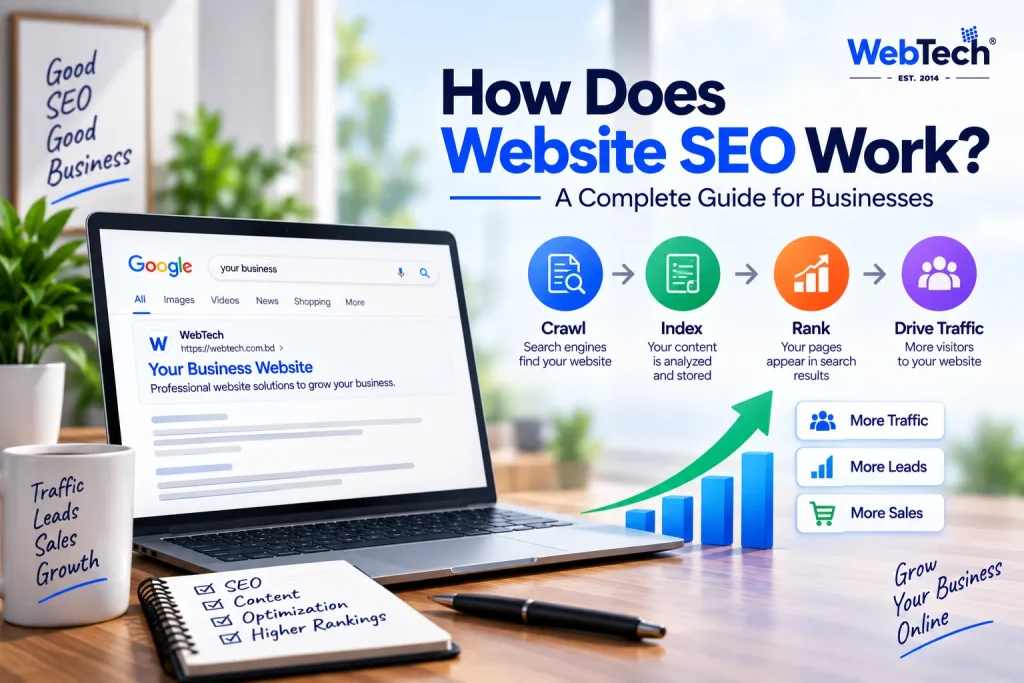
Website SEO is the process of improving a website’s content, structure, technical performance, and authority so search engines can better understand its pages and users can find relevant information through organic search.
In simple terms, SEO helps your website become easier to find when people search for the products, services, or information your business provides.
For a business website, SEO is not just about adding keywords. It involves everything from website structure and page content to loading speed, mobile usability, internal links, technical setup, and online authority.
What Is Website SEO?
Website SEO, or search engine optimization, is the practice of improving a website so it can perform better in organic search results.
When someone searches Google for a product or service, search engines need to determine which pages are most relevant to that search. SEO helps search engines understand what your website is about and whether a particular page is useful for the searcher.
Website SEO can involve:
- Keyword research
- Search intent analysis
- Page optimization
- Technical SEO
- Content optimization
- Internal linking
- Website structure
- Mobile optimization
- Page speed
- Structured data
- Link building and authority
Good SEO is not about making a website attractive to search engines at the expense of people. The goal is to build a website that is useful for both users and search engines.
Why Does SEO Matter for a Business Website?
Having a website does not automatically mean that people will find it through Google.
A business may have an excellent website, but if its pages are poorly structured, difficult to crawl, slow on mobile devices, or do not address what people are searching for, it may struggle to attract organic traffic.
SEO can help a business:
- Increase organic visibility
- Reach people actively searching for its services
- Build long-term search traffic
- Improve website usability
- Generate relevant leads
- Support brand visibility
- Reduce dependence on paid advertising
For example, a company offering web development in Bangladesh may want to appear when potential customers search for terms such as “website development company in Bangladesh” or “eCommerce website development.”
The website needs more than those keywords. It needs useful pages that properly answer the intent behind those searches.
How Does Website SEO Work?
Website SEO works through several connected processes. Each one contributes to how search engines understand, evaluate, and rank a website.
Keyword Research
Keyword research is usually one of the first steps in an SEO campaign.
The objective is not simply to find keywords with high search volume. You need to understand what people actually want when they search those terms.
For example:
- “website” is broad.
- “website development company in Bangladesh” has a commercial intent.
- “How does website development work?” has an informational intent.
- “eCommerce website price in Bangladesh” has a pricing intent.
These searches may relate to the same general topic, but the user expects a different type of page for each one.
Good keyword research helps identify:
- Relevant search terms
- Search intent
- Topic opportunities
- Long-tail keywords
- Commercial keywords
- Local searches
- Questions people ask
The goal is to match the right keyword and topic with the right page.
Search Intent
Search intent refers to the reason behind a search.
Someone searching “how does website SEO work?” is probably looking for an explanation.
Searching “SEO services in Bangladesh” may be comparing service providers.
Someone searching “website SEO price“ is more likely researching cost.
Understanding this difference is essential.
Common search intent types include
Informational Intent
The user wants to learn something.
Examples:
- How does SEO work?
- What is technical SEO?
- How does website development work?
Commercial Investigation
The user is researching options before making a decision.
Examples:
- Best SEO company in Bangladesh
- Website development packages
- eCommerce website price in Bangladesh
Transactional Intent
The user is ready to take action.
Examples:
- Hire an SEO company
- Buy website development service
- Get an SEO quote
Navigational Intent
The user is looking for a specific website, company, or page.
SEO works better when each page is created around a clear search intent instead of trying to rank one page for everything.
On-Page SEO
On-page SEO involves optimizing the elements users and search engines can find on a webpage.
Important elements include:
- Page title
- H1 heading
- H2 and H3 headings
- Main content
- Keywords
- Images
- Image alt text
- Internal links
- URLs
- Meta description
- Relevant structured data
The important thing is balance.
Repeating the same keyword dozens of times does not make a page better. In many cases, it makes the writing uncomfortable to read.
Instead, a page should naturally cover the topic and related concepts.
For example, an article about website SEO may naturally discuss:
- Technical SEO
- Search intent
- Keywords
- Content
- Internal links
- Website speed
- Mobile usability
- Structured data
This gives search engines stronger context about the subject.
Technical SEO
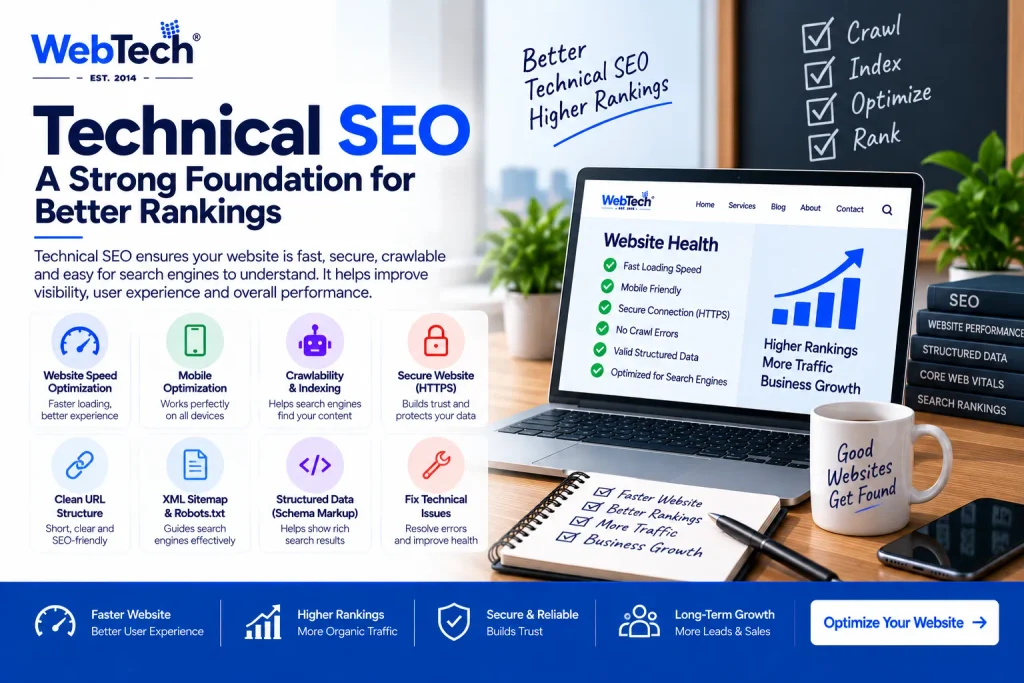
Technical SEO focuses on the parts of a website that affect crawling, indexing, performance, and usability.
Important technical SEO areas include:
Website Speed
Pages should load efficiently, particularly on mobile devices.
Mobile Usability
The website should work properly across smartphones, tablets, and desktop computers.
Crawlability
Search engine crawlers need to be able to access important pages.
Indexability
Search engines need to understand which pages should be included in their index.
HTTPS
Secure connections are important for modern websites.
XML Sitemap
A sitemap can help search engines discover important URLs.
Robots.txt
Robots.txt can provide crawling instructions for search engine bots.
Canonical URLs
Canonicalization helps communicate the preferred version of a URL when similar or duplicate URLs exist.
Core Web Vitals
User experience and page performance can be evaluated using Google’s Core Web Vitals and other performance signals.
Technical SEO does not replace useful content. It provides the technical foundation that allows good content to be properly discovered and understood.
Internal Linking
Internal linking means linking one page of your website to another relevant page on the same website.
It sounds simple, but it can have a significant role in website architecture.
For example, an article about website SEO could naturally link to:
website development company in Bangladesh
which leads to a relevant website development service page.
It could also link to:
for readers interested in building an online store.
A good internal linking structure helps users discover related information and helps search engines understand how different pages on your website are connected.
For WebTech, a useful structure could be:
Website Development
↓
Website SEO
↓
eCommerce Development
↓
SEO Services
↓
↓
Pricing / Quote
The links should always make sense in context. Avoid adding links simply to increase the number of internal links on a page.
Content Optimization
Content is one of the most visible parts of SEO.
But SEO content is not simply content filled with keywords.
Useful content should:
- Answer the user’s question
- Provide accurate information
- Be easy to understand
- Cover the topic adequately
- Use logical headings
- Provide useful examples
- Address related questions
- Give the reader a clear next step
For informational articles, answering the main question early can be particularly useful.
For commercial pages, the content should explain the service, benefits, process, pricing factors, and next steps without unnecessary filler.
The best approach is to write for the person first and optimize for search engines as part of the process.
Structured Data
Structured data helps provide search engines with additional information about the content of a page.
Depending on the page, appropriate structured data may include:
- Article
- BreadcrumbList
- Organization
- Local Business
- Product
- Service
- FAQPage
Structured data does not guarantee a higher ranking or a special search result.
Its purpose is to provide clearer machine-readable information about the page when the markup is appropriate and correctly implemented.
For example, an article can use Article structured data, while a page containing genuine visible FAQs may use FAQPage structured data.
Authority Building
SEO is not limited to what happens on your own website.
A website’s authority and reputation can also be influenced by signals from other websites and online sources.
Authority-building activities may include:
- Earning relevant backlinks
- Publishing useful original content
- Digital PR
- Industry mentions
- Business citations
- Brand mentions
- Creating genuinely useful resources
The focus should be on earning recognition rather than collecting large numbers of low-quality links.
A single relevant and trustworthy reference can be more valuable than dozens of unrelated links.
SEO-Friendly Website Development
SEO should ideally be considered before a website is finished, not after everything has already been built.
Website architecture, URLs, navigation, mobile responsiveness, page speed, content structure, internal linking, and technical SEO can all be considered during development.
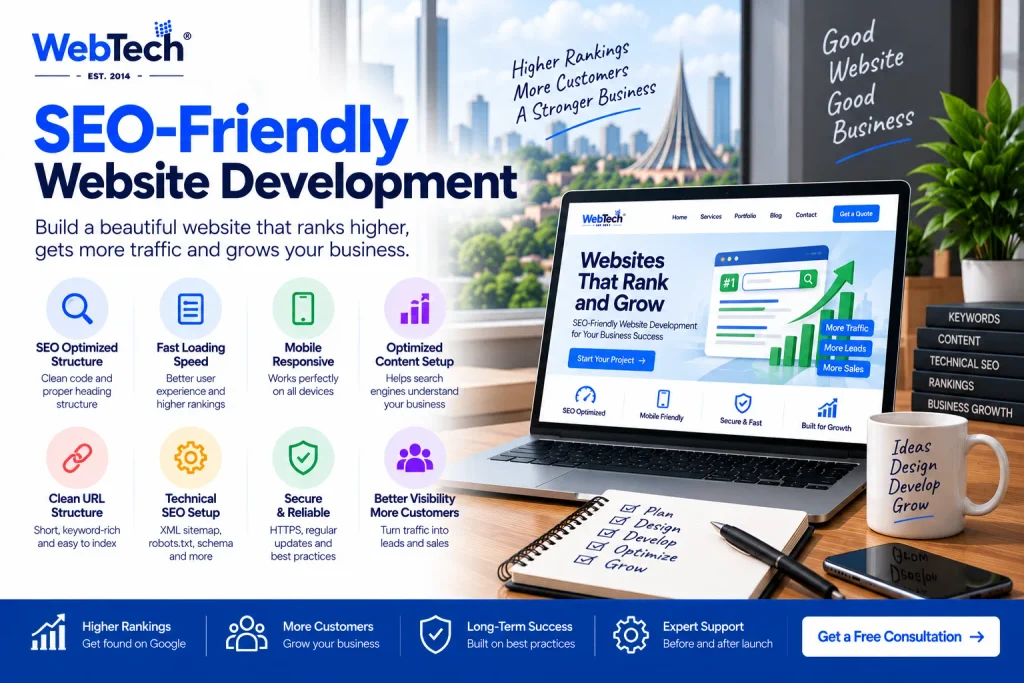
This is why website development and SEO work well together.
If the website is built with search visibility in mind from the beginning, many technical SEO problems can be avoided later.
WebTech combines website development and SEO to help businesses build websites that are designed for users, search engines, and business goals.
For businesses looking for a website development company in Bangladesh, this approach can create a stronger foundation for future organic growth.
Website SEO vs Regular Website
A website can look excellent and still have a weak SEO foundation.
Here is a simple comparison:
| Regular Website | SEO-Friendly Website |
|---|---|
| Basic structure | Search-friendly structure |
| Focus mainly on design | Design + SEO |
| Limited optimization | On-page optimization |
| Basic navigation | Optimized architecture |
| May lack structured data | Schema where appropriate |
| No clear content strategy | Content aligned with search intent |
| Limited technical SEO planning | Technical SEO considered during development |
The difference is not necessarily visible from the homepage.
A well-designed SEO-friendly website considers what happens behind the interface as well as what visitors see.
How SEO and Website Development Work Together
Website development creates the technical foundation.
SEO helps that foundation become easier for search engines to understand and easier for users to discover.
For example:
Website Development
→ Site structure
→ Mobile responsiveness
→ Functionality
→ Performance
→ URLs
SEO
→ Keyword targeting
→ Search intent
→ Content
→ Internal linking
→ Technical optimization
Together, they support:
Better Website → Better Search Visibility → Relevant Traffic → Potential Leads
This is why SEO should be considered during the website development process rather than treated as a completely separate activity.
Website SEO for eCommerce Websites
eCommerce SEO has some additional challenges because online stores can contain hundreds or thousands of URLs.
Important areas include:
- Product pages
- Category pages
- Product descriptions
- Product schema
- Breadcrumbs
- Internal linking
- Filters
- Search functionality
- Duplicate content management
- Image optimization
- Page speed
- Mobile usability
For example, an online fashion store may have separate pages for categories, brands, products, sizes, colors, and other filters.
Without proper architecture, search engines may have difficulty understanding which pages are important.
This is why SEO planning is particularly important when developing an eCommerce website.
Businesses planning an online store can also explore eCommerce website development based on their product range and business requirements.
Local SEO for Business Websites
Local SEO focuses on helping businesses become more visible for searches connected to a specific geographic area.
For a Bangladesh-based business, this may involve searches such as:
- SEO company in Dhaka
- Website development company in Bangladesh
- Web design company in Dhaka
- Local SEO services in Bangladesh
Local SEO can involve:
- Google Business Profile optimization
- Location-focused website content
- Business information consistency
- Local landing pages
- Relevant local citations
- Customer reviews
- Local structured data
- Location-based search intent
For businesses serving specific cities or areas, local SEO can complement broader national SEO.
If your business depends on customers from a particular location, local SEO services can be an important part of your search strategy.
How Long Does Website SEO Take?
SEO does not normally produce meaningful results overnight.
The timeline depends on factors such as:
- Website age
- Competition
- Industry
- Keyword difficulty
- Existing authority
- Technical condition
- Content quality
- Search intent
- Backlink profile
- Consistency of optimization
Some technical improvements can have relatively quick effects, while competitive keyword growth may take considerably longer.
SEO should therefore be treated as an ongoing process rather than a one-time website task.
Website SEO Services in Bangladesh
Businesses in Bangladesh may need SEO for different reasons.
A local service business may want more calls and inquiries.
An eCommerce business may want more product visibility.
A professional services company may want to rank for industry-specific searches.
A new website may need a strong technical and content foundation.
A mature website may need an SEO audit, content expansion, technical improvements, or authority development.
WebTech provides SEO services in Bangladesh based on the website’s current condition, target audience, competition, and business objectives.
The right SEO strategy depends on the actual website rather than a fixed checklist applied to every business.
Why Choose WebTech for Website SEO?
SEO should connect search visibility with a real business objective.
At WebTech, the focus can include:
Search Intent
Understanding what users actually want from a search query.
Technical Foundation
Making sure important technical SEO elements are properly considered.
Useful Content
Creating content that answers real questions instead of producing pages purely for keywords.
Website Structure
Building logical navigation and internal linking between related topics.
Local Visibility
Supporting businesses targeting customers in Bangladesh or specific locations.
eCommerce SEO
Optimizing online stores around product, category, commercial, and transactional searches.
Long-Term Growth
Building an SEO foundation that can continue to improve as the website grows.
Website Development and SEO: A Better Approach
A business does not have to choose between having a good website and having an SEO-friendly website.
The two can be planned together.
A strong digital foundation can follow this path:
Business Goal
↓
Website Planning
↓
Website Development
↓
SEO Optimization
↓
Organic Visibility
↓
Relevant Traffic
↓
Leads & Sales
The exact strategy will depend on the business, industry, audience, and competition
Frequently Asked Questions
How does website SEO work?
Website SEO works by optimizing a website’s content, structure, technical performance, and authority so search engines can better understand its pages and users can find relevant information through organic search.
What are the main parts of website SEO?
The main parts include keyword research, search intent, on-page SEO, technical SEO, internal linking, content optimization, structured data, and authority building.
Why is SEO important for a business website?
SEO can help a business improve organic visibility, reach people searching for relevant products or services, attract qualified website visitors, and generate potential leads.
Is SEO part of website development?
SEO and website development are different disciplines, but they work closely together. Website development creates the technical foundation, while SEO improves the website’s ability to be understood and discovered through search.
Should SEO be done before or after website development?
SEO should ideally be considered during website planning and development. This allows important elements such as site structure, URLs, mobile usability, page speed, and internal linking to be planned correctly from the beginning.
How long does website SEO take?
The timeline varies depending on competition, website condition, content quality, authority, target keywords, and other factors. SEO is generally an ongoing process rather than a one-time activity.
What is technical SEO?
Technical SEO focuses on aspects such as crawling, indexing, site architecture, page speed, mobile usability, HTTPS, XML sitemaps, canonical URLs, and other technical elements that help search engines access and understand a website.
Can SEO help an eCommerce website?
Yes. eCommerce SEO can help improve the visibility of product and category pages through optimized content, site architecture, internal linking, structured data, technical SEO, and search-intent-focused optimization.
What is local SEO?
Local SEO focuses on improving a business’s visibility for searches connected to a specific geographic location. It can involve Google Business Profile optimization, local content, business information, reviews, citations, and local structured data.
Get SEO Support for Your Website
A website should do more than exist online. It should make it easy for the right people to find your business and understand what you offer.
Whether you are building a new website, improving an existing website, launching an eCommerce store, or trying to increase organic visibility, SEO can be incorporated into the overall digital strategy.
WebTech provides website development and SEO services in Bangladesh to help businesses build search-friendly, user-focused websites.
Need help with your website SEO? Contact WebTech to discuss your goals and requirements.






Comments
Comments are closed.