
What Is Website Development? Complete Guide for Businesses in Bangladesh
Website development is the process of planning, building, testing, launching, and maintaining a website or web application. It can include website structure, front-end development, back-end functionality, databases, content management systems, integrations, security, performance, deployment, and ongoing maintenance.
For a business, website development is more than putting a few pages online. A professional website should explain what your business offers, make it easy for customers to take action, work properly on mobile devices, provide a reliable user experience, and create a strong foundation for SEO and digital marketing.
If you are a business owner in Bangladesh wondering what website development means, how websites are built, what type of website you need, how much development can cost, or when you should hire a professional website development company, this guide explains the process from a practical business perspective.
Need a Website for Your Business? Get a Free Quote
Call / WhatsApp: +880 1339397906
What Is Website Development?
Website development refers to the technical and practical process of creating and maintaining a website.
It can range from developing a simple business website with a few informational pages to building a complex eCommerce platform, customer portal, booking system, dashboard, or custom web application.
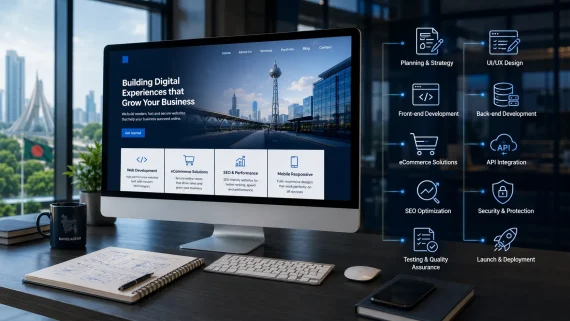
A complete website development project may involve:
- Website planning
- Sitemap and information architecture
- UI/UX design
- Front-end development
- Back-end development
- Database configuration
- CMS implementation
- eCommerce functionality
- API integrations
- Payment gateway integration
- Website security
- Performance optimization
- SEO-friendly technical setup
- Testing
- Deployment
- Maintenance
The exact requirements depend on the type of website and the goals of the business.
For example, a small service business may only need a professional website with service pages, contact information, a lead form, WhatsApp integration, and location information. An online retailer may need product management, shopping cart functionality, payment processing, delivery configuration, inventory management, customer accounts, and order management.
This is why there is no single website development solution that is suitable for every business.
What Is the Difference Between Web Design and Website Development?
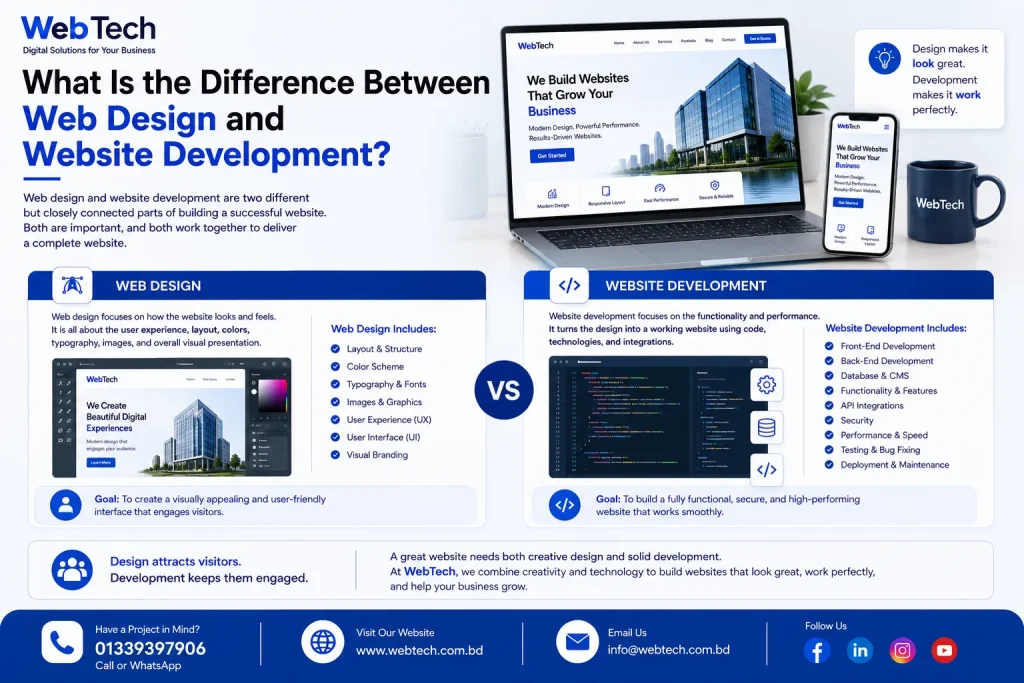
Website design and website development are closely related, but they are not exactly the same thing.
Web Design
Web design focuses primarily on how a website looks and how users interact with it.
It can include:
- Layout
- Typography
- Colors
- Images
- Visual hierarchy
- Navigation
- User interface
- User experience
- Responsive layouts
- Buttons and calls to action
A designer considers how information should be presented so that visitors can understand the website and navigate it easily.
Website Development
Website development focuses on turning the planned design and requirements into a functioning website.
It can include:
- Front-end development
- Back-end programming
- CMS configuration
- Database functionality
- Forms
- User accounts
- APIs
- Payment systems
- Custom functionality
- Testing
- Deployment
A Complete Website Requires Both
For most professional projects, design and development work together.
Planning → Design → Development → Testing → Launch
A visually attractive website that does not work properly is not a successful website. Similarly, a technically functional website with poor usability can make it difficult for visitors to understand the business.
What Does Website Development Include?
Website development can involve several stages and technical areas depending on the project.
Website Planning
Before development begins, the project requirements should be understood.
Planning can include:
- Business objectives
- Target audience
- Website type
- Required pages
- Features
- Content requirements
- Integrations
- Technology or CMS
- Budget
- Project timeline
A clear plan reduces confusion during development and helps establish what is included in the project.
Website Structure
A website needs a logical structure so visitors and search engines can understand the relationship between pages.
For example:
Home → Services → Service Details → Contact
An eCommerce website may have:
Home → Shop → Category → Product → Cart → Checkout
The structure should reflect the way users are expected to navigate the website.
UI/UX Design
The user interface determines how the website looks and how visitors interact with it.
UX considerations can include:
- Navigation
- Page hierarchy
- Content placement
- Forms
- Buttons
- Calls to action
- Mobile usability
- User journey
The goal is to make important information and actions easy to find.
Front-End Development
Front-end development involves the parts of the website that visitors see and interact with.
Common technologies include:
- HTML
- CSS
- JavaScript
Front-end development can control page layouts, menus, buttons, forms, animations, responsive behavior, and interactive elements.
Back-End Development
Back-end development handles functionality that operates behind the visible interface.
Depending on the project, this can include:
- Server-side programming
- Databases
- User accounts
- Authentication
- Order management
- Data processing
- APIs
- Business logic
- Administrative functionality
The technology used depends on the project’s requirements and development environment.
Content Management Systems
A content management system, or CMS, allows website owners to manage certain content without changing the underlying code for every update.
For suitable projects, a CMS can be useful for:
- Blog posts
- Service pages
- Product management
- Images
- Website content
- Categories
- Users
WordPress is one example of a widely used CMS. Other technologies may be more suitable for projects requiring specialized functionality.
Database Development
Websites that need to store and retrieve structured information may use databases.
Examples include:
- Products
- Orders
- Customers
- User accounts
- Blog content
- Form submissions
- Inventory
The database structure should match the functionality required by the website.
API and Third-Party Integrations
Some websites need to communicate with external systems.
Examples can include:
- Payment gateways
- CRM systems
- Delivery services
- Email platforms
- Analytics platforms
- Business software
- External APIs
The exact integrations depend on the requirements of the project.
Testing
Before launch, the website should be tested.
Testing can include:
- Mobile responsiveness
- Desktop layout
- Navigation
- Contact forms
- Buttons
- Links
- Checkout
- Login
- Payment functionality
- Browser compatibility
- Basic performance
- Security configuration
Testing helps identify problems before customers encounter them.
Deployment
Once the website is ready, it needs to be deployed to a live hosting environment and connected to its domain.
This can involve:
- Hosting configuration
- Domain configuration
- SSL
- Database setup
- File deployment
- DNS configuration
- Email configuration
- Search engine setup
Maintenance
Website development does not necessarily end when a website goes live.
Ongoing maintenance may involve:
- Software updates
- Security updates
- Backups
- Content updates
- Bug fixes
- Performance improvements
- Technical changes
- Feature improvements
How Does Website Development Work?
A professional website development project usually follows a structured workflow.
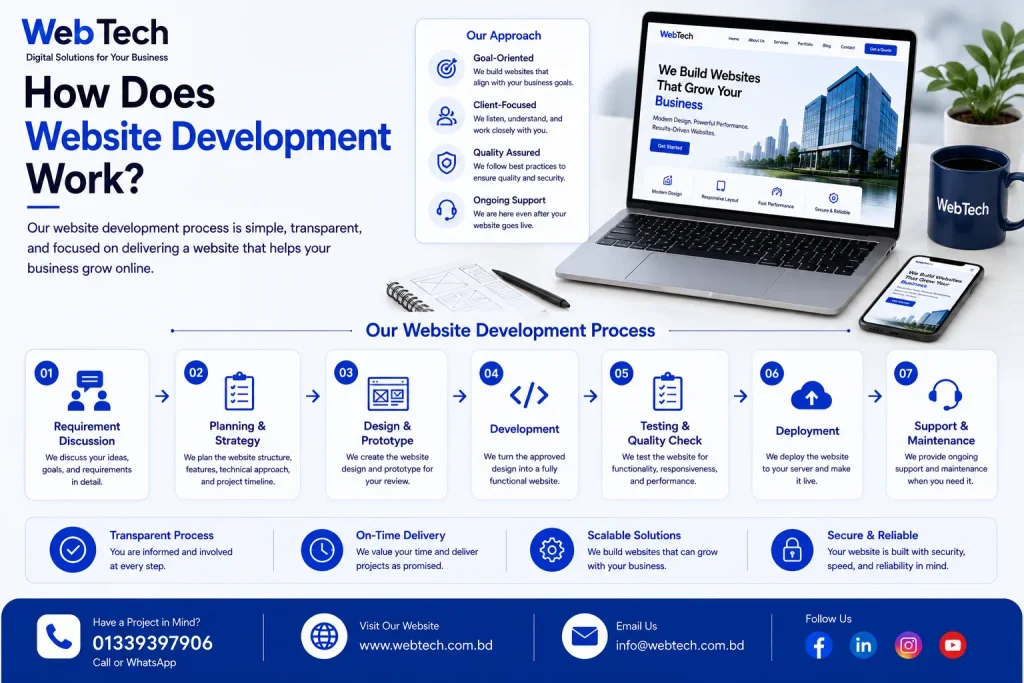
1. Requirement Discovery
The first step is understanding the business and the website’s purpose.
Questions may include:
- What does the business do?
- Who are the target customers?
- What services or products are being offered?
- What pages are required?
- Does the business need eCommerce?
- Are there existing systems to integrate?
- What actions should visitors take?
- Is the website new or being redesigned?
2. Website Planning
The development team creates a structure for the website.
This may include:
- Sitemap
- Navigation
- Page hierarchy
- Feature list
- Content requirements
- Technical requirements
3. UI/UX Design
The visual and interaction system is developed based on the project requirements.
The design should reflect the business brand while keeping usability in mind.
4. Development
The approved structure and design are converted into a functioning website.
This may involve CMS configuration, front-end development, back-end development, database work, and integrations.
5. Content Integration
The website’s text, images, products, services, forms, and other content are added.
Content should be organized around both user needs and search intent.
6. Testing
The website is checked across relevant devices and browsers.
Important functionality is tested before launch.
7. Technical SEO Setup
Depending on the project scope, the website may be prepared with:
- Search-friendly URLs
- Proper heading structure
- Metadata
- Internal linking
- XML sitemap
- Canonical configuration
- Schema markup
- Mobile-friendly structure
- Image optimization
8. Launch
After final approval, the website is deployed to the live domain.
9. Maintenance and Growth
After launch, businesses can continue improving content, SEO, performance, security, functionality, and conversion rates.
What Are the Different Types of Website Development?
Website development can take different forms depending on the purpose of the website.
Business Website Development
A business website presents a company’s services, products, contact information, experience, location, and other important information.
A business website can include:
- Home
- About
- Services
- Service details
- Portfolio
- Testimonials
- FAQ
- Contact
- Blog
This type of website is suitable for many small and medium-sized businesses.
Explore Business Website Development
eCommerce Website Development
An eCommerce website allows businesses to sell products or services online.
Common functionality includes:
- Product management
- Categories
- Product search
- Shopping cart
- Checkout
- Payment gateway
- Order management
- Delivery
- Inventory
- Customer accounts
- Coupons
The requirements can vary significantly depending on the size and business model of the online store.
Explore eCommerce Website Development
Corporate Website Development
Corporate websites are designed for companies that need to present their organization, services, products, team, projects, clients, and business information professionally.
A corporate website may contain:
- Company profile
- Services
- Products
- Team
- Projects
- Clients
- Certifications
- News
- Contact information
Portfolio Website Development
Portfolio websites are designed to showcase professional work.
They can be useful for:
- Designers
- Developers
- Architects
- Photographers
- Consultants
- Freelancers
- Artists
- Professionals
News Portal Website Development
News websites require content publishing, categories, authors, media, archives, search, and other publishing functionality.
Custom Web Application Development
Some businesses need functionality that is not available through a standard website package.
A custom web application may include:
- User dashboards
- Customer portals
- Business workflows
- Advanced forms
- Custom databases
- APIs
- Automation
- Specialized functionality
Front-End vs Back-End vs Full-Stack Development
Understanding these terms can help business owners understand what is involved in website development.
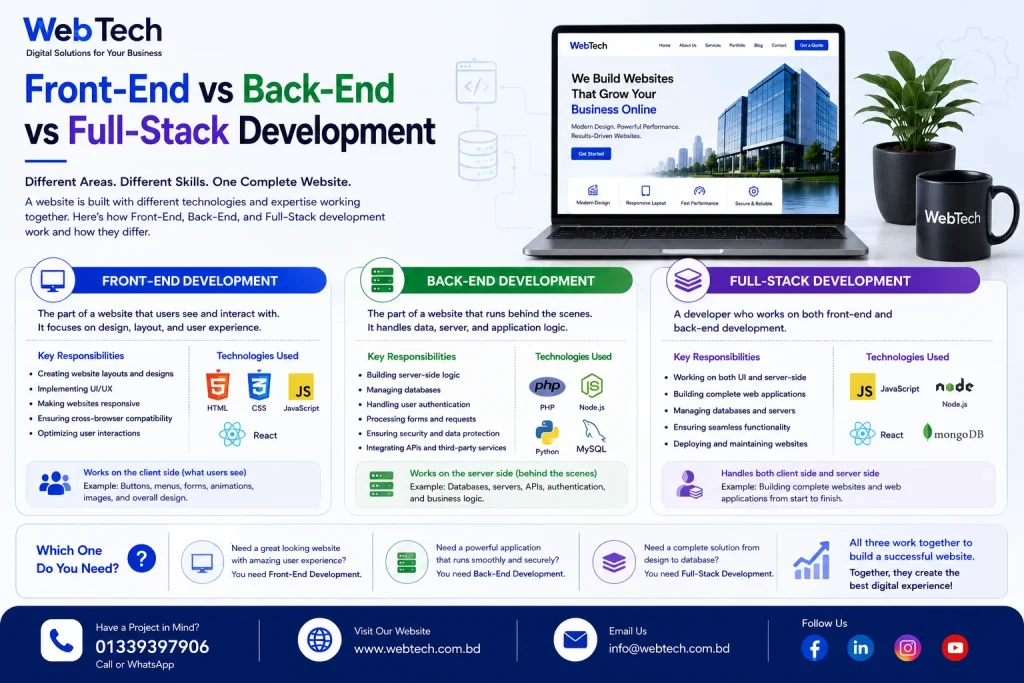
Front-End Development
Front-end development deals with what users see and interact with.
Examples include:
- Layout
- Navigation
- Buttons
- Forms
- Images
- Interactive components
Back-End Development
Back-end development handles server-side processes and functionality.
Examples include:
- Database operations
- Authentication
- Orders
- User accounts
- Business logic
- API processing
Full-Stack Development
Full-stack development involves both front-end and back-end development.
The appropriate approach depends on the requirements of the project.
What Technologies Are Used in Website Development?
Website development can involve different technologies depending on the type and complexity of the project.
HTML
HTML provides the basic structure of web pages.
CSS
CSS controls presentation, styling, layouts, spacing, typography, and responsive behavior.
JavaScript
JavaScript can provide interactive functionality within a website.
PHP and Other Server-Side Technologies
Server-side technologies can process requests, handle data, interact with databases, and support website functionality.
WordPress and Other CMS Platforms
CMS platforms can simplify content management for suitable website projects.
Databases
Databases store and organize information required by websites and web applications.
APIs
APIs allow websites and applications to communicate with external systems.
The best technology depends on the project’s requirements rather than simply choosing the most popular technology.
What Makes a Website SEO-Friendly?
Website development and SEO are different disciplines, but development provides an important technical foundation for search visibility.
An SEO-friendly website can include:
Search-Friendly URLs
URLs should be logical, descriptive, and easy to understand.
Clear Website Architecture
Important pages should be easy for users and search engines to discover.
Proper Heading Structure
Headings should organize content logically.
Mobile Responsiveness
The website should provide a good experience on mobile devices.
Performance
Pages should load efficiently and avoid unnecessary technical overhead.
Image Optimization
Images should be appropriately sized and optimized.
Internal Linking
Relevant pages should be connected through logical internal links.
XML Sitemap
A sitemap can help search engines discover important URLs.
Canonical URLs
Canonical configuration can help search engines understand preferred versions of pages where necessary.
Schema Markup
Structured data can help search engines understand entities and content types when implemented correctly.
Crawlability and Indexability
Important pages should be accessible to search engines and should not accidentally be blocked from crawling or indexing.
Website development provides the foundation, but ongoing SEO also involves content, search intent, authority, links, competition, technical monitoring, and continuous optimization.
Website Development for Businesses in Bangladesh
Businesses in Bangladesh can have specific requirements when developing a website.
A website may need to support:
- Bangla content
- English content
- Mobile-first users
- Local business information
- Google Maps
- WhatsApp communication
- Local payment systems
- Online ordering
- Delivery services
- Local SEO
- Social media integration
For eCommerce businesses, payment and delivery requirements should be discussed before development so that the website architecture can accommodate the selected systems.
Depending on the business model, local payment or communication options may include services such as bKash, Nagad, payment gateways, WhatsApp, and other third-party systems.
The actual integration depends on the provider, technical requirements, account availability, and project scope.
How Much Does Website Development Cost in Bangladesh?
There is no single website development price that applies to every project.
The cost can depend on:
- Website type
- Number of pages
- Design requirements
- Functionality
- CMS
- eCommerce features
- Payment gateway
- Third-party integrations
- Content
- Custom development
- SEO requirements
- Support and maintenance
For example, a simple business website generally requires a different scope from an eCommerce store with hundreds of products or a custom web application.
WebTech offers selected basic website solutions starting from ৳9,999, while selected eCommerce website solutions start from ৳11,999.
The final price depends on the actual requirements of the project.
For a detailed breakdown of website pricing, see:
Website Development Cost in Bangladesh
What Features Should a Business Website Have?
A business website should be designed around the actions you want visitors to take.
Essential Features
- Responsive design
- Clear navigation
- Business information
- About page
- Service pages
- Contact page
- Contact form
- SSL
- Mobile-friendly layout
Lead Generation Features
- Call button
- WhatsApp button
- Quote request
- Contact forms
- Service-specific CTAs
- Testimonials
- Portfolio
- Location information
Advanced Features
Depending on the business, you may also need:
- Booking system
- Customer login
- Online payments
- Product management
- CRM integration
- API integration
- Customer dashboard
- Admin dashboard
The right features are the ones that support your actual business requirements.
WordPress vs Custom Website Development
One of the common decisions businesses face is whether to use a CMS such as WordPress or build a more customized solution.
WordPress
WordPress can be suitable when you need:
- Content management
- Business pages
- Blog publishing
- Flexible themes and plugins
- eCommerce through suitable extensions
- Easy content updates
Custom Development
Custom development may be more appropriate when the project requires:
- Specialized workflows
- Advanced business logic
- Custom dashboards
- Complex integrations
- Unique functionality
- Specialized data structures
Neither option is automatically better for every business.
The correct choice depends on your requirements, budget, technical needs, future plans, and expected maintenance.
Not sure which option is right for your business? Talk to WebTech.
How Long Does Website Development Take?
Website development timelines vary according to project scope.
A simple website with a limited number of pages can require much less development work than a large eCommerce website or custom web application.
Factors affecting the timeline include:
- Number of pages
- Design complexity
- Content readiness
- Number of products
- Custom functionality
- Integrations
- Payment systems
- Revision cycles
- Client approvals
- Testing requirements
A project can move faster when the required content, branding materials, references, and functionality requirements are prepared before development begins.
For an accurate timeline, discuss your project requirements with the development team.
Website Development vs Website Builder
Website builders can be useful for simple projects where the owner wants to create and manage a website independently.
Professional website development may be more suitable when you need:
- Custom design
- Professional UX
- eCommerce functionality
- Custom features
- Third-party integrations
- SEO-friendly architecture
- Performance optimization
- Professional support
The right option depends on the complexity of your website and how important the website is to your business.
When Should You Hire a Website Development Company?
You may benefit from professional website development when:
You Are Starting a New Business
A professional website can establish your online presence and provide customers with reliable business information.
Your Current Website Is Outdated
An old design, poor mobile experience, or difficult navigation can affect how visitors perceive your business.
You Need eCommerce
Selling products online requires more than displaying product images. You may need cart, checkout, payments, orders, delivery, and inventory functionality.
You Need Custom Features
If your business has specialized workflows or integrations, custom development may be appropriate.
You Want Better Lead Generation
A professional website can be structured around service pages, CTAs, forms, calls, WhatsApp, and other conversion actions.
You Want an SEO-Friendly Foundation
A properly structured website can make ongoing SEO work easier.
You Don’t Have an In-House Developer
A professional development company can handle planning, design, development, testing, launch, and technical support according to the project scope.
How to Choose a Website Development Company in Bangladesh
Choosing a website development company should not be based only on the lowest price.
Check the Portfolio
Look for websites similar to the type of project you need.
Understand the Scope
Ask exactly what is included in the quoted price.
Check Technical Capabilities
Make sure the company can implement the features and integrations your business requires.
Discuss Ownership
Clarify access and ownership of your domain, hosting, website files, CMS, and other relevant assets.
Ask About Support
Understand what support is available after the website launches.
Review SEO Considerations
Ask whether the website will have a logical structure, mobile responsiveness, search-friendly URLs, metadata controls, sitemap, and other relevant technical foundations.
Compare Value, Not Just Price
A cheaper quote may have fewer pages, limited functionality, less support, or fewer included services.
Compare the actual scope before making a decision.
Common Website Development Mistakes
Businesses can avoid many problems by planning the project carefully.
Choosing Only Based on Price
The cheapest website may not provide the functionality, design quality, support, or scalability your business needs.
Starting Without a Sitemap
Without a clear structure, important pages can be missed or poorly organized.
Ignoring Mobile Users
A website that works well only on desktop can provide a poor experience for a large part of its audience.
Using Poor Content
A website needs clear and useful information about its products, services, business, and customers.
No Clear Call to Action
Visitors should know what to do next.
Examples include:
Book a Consultation
Ignoring Security
SSL, secure access, updates, backups, and appropriate security practices should be considered.
No Analytics
Analytics can help businesses understand how visitors interact with the website.
No Maintenance Plan
Websites can require updates, security maintenance, content changes, and technical improvements after launch.
Website Development Checklist
Before Development
- Define business goals
- Identify target customers
- Decide website type
- Prepare sitemap
- List required pages
- Identify required features
- Prepare branding assets
- Prepare content
- Choose appropriate technology
- Set project scope
During Development
- Review design
- Check responsive layouts
- Add content
- Configure functionality
- Test forms
- Test integrations
- Review navigation
- Optimize images
Before Launch
- Test mobile experience
- Test desktop experience
- Check links
- Test forms
- Check payment functionality if applicable
- Configure SSL
- Review metadata
- Check headings
- Configure sitemap
- Configure analytics
- Review indexing settings
- Create a backup
After Launch
- Monitor performance
- Update software
- Maintain security
- Publish new content
- Monitor SEO
- Review analytics
- Fix technical issues
- Improve conversion elements
- Update website information
Website Development and Business Growth
A website should not be treated as a one-time digital brochure.
After launch, businesses can use the website as a foundation for:
- SEO
- Content marketing
- Google Ads
- Social media campaigns
- Lead generation
- Email marketing
- eCommerce
- Customer communication
- Brand building
For example, a service business can create dedicated pages for each service and location. An eCommerce business can build category and product pages. A professional can publish case studies and portfolio projects. A corporate company can create pages for its products, industries, projects, and expertise.
This allows the website to grow alongside the business.
Why Website Development and SEO Should Work Together
Website development creates the technical and structural foundation. SEO builds on that foundation through content, search intent, authority, technical optimization, internal linking, and other activities.
A website can be technically well developed and still struggle to rank if it does not provide useful content or compete effectively for its target searches.
Similarly, strong SEO content can underperform if the website has serious technical problems, poor mobile usability, slow performance, weak architecture, or indexing issues.
For this reason, website development and SEO should be considered complementary rather than interchangeable.
Why Choose WebTech for Website Development?
WebTech provides website solutions for businesses, professionals, organizations, and online businesses in Bangladesh.
Depending on project requirements, WebTech can work on:
- Business websites
- eCommerce websites
- Corporate websites
- Portfolio websites
- Custom websites
- Website redesign
- Industry-specific websites
- Website maintenance
The development approach should be based on the actual requirements of your project rather than forcing every business into the same website package.
WebTech also offers website solutions at different price points, including selected basic website solutions starting from ৳9,999 and selected eCommerce solutions starting from ৳11,999.
Before starting a project, you can discuss your requirements, required features, website type, budget, and expected outcome with the WebTech team.
View WebTech Website Development Services
Frequently Asked Questions
What is website development?
Website development is the process of planning, building, testing, launching, and maintaining a website or web application. It can involve front-end development, back-end development, databases, CMS configuration, integrations, security, performance, and deployment.
What is the difference between website design and website development?
Website design focuses primarily on visual presentation and user experience, while website development focuses on implementing the website’s functionality and technical structure. A professional website typically requires both design and development.
What does a website development company do?
A website development company can help plan, design, develop, test, launch, and maintain websites. Depending on the company and project, services may include business websites, eCommerce websites, custom development, integrations, redesign, and technical support.
How much does website development cost in Bangladesh?
The cost depends on the website type, number of pages, design requirements, functionality, integrations, content, eCommerce features, and support. WebTech offers selected basic website solutions starting from ৳9,999 and selected eCommerce solutions starting from ৳11,999.
How long does it take to develop a website?
The timeline depends on the project scope, number of pages, design complexity, content readiness, features, integrations, revisions, and testing requirements. A simple business website generally requires less work than a complex eCommerce or custom web application.
What are the different types of website development?
Common types include business website development, eCommerce website development, corporate website development, portfolio website development, CMS-based development, news portal development, and custom web application development.
What is custom website development?
Custom website development involves building functionality and website structures around specific business requirements rather than relying entirely on a standard template or predefined setup.
Is WordPress suitable for business websites?
WordPress can be suitable for many business websites because it provides a content management system and a large ecosystem of themes and plugins. The appropriate platform depends on the website’s functionality, budget, maintenance requirements, and future plans.
Is website development important for SEO?
Yes. Website development can provide the technical foundation required for SEO, including website architecture, mobile responsiveness, performance, URLs, headings, internal linking, structured data, sitemap configuration, and crawlability. However, ranking also requires quality content, authority, relevance, and ongoing optimization.
What features should a business website have?
A business website commonly needs responsive design, clear navigation, service pages, business information, contact details, forms, calls to action, mobile compatibility, SSL, and a search-friendly structure. Additional features depend on the business.
How do I choose a website development company in Bangladesh?
Review the company’s portfolio, technical capabilities, project scope, pricing, support, ownership terms, development process, and relevant experience. Compare the actual deliverables rather than choosing only based on the lowest price.
Can WebTech develop an eCommerce website?
Yes. WebTech provides eCommerce website development for businesses that want to sell products online. Features depend on the project and may include products, categories, cart, checkout, payment, delivery, orders, inventory, and customer functionality.
Can WebTech build a custom business website?
Yes. WebTech can discuss custom website requirements involving specific functionality, integrations, workflows, forms, dashboards, and other business requirements.
Need a Professional Website for Your Business?
A professional website should do more than look attractive.
It should help your customers understand your business, find your services, trust your brand, take action, and contact you.
Whether you need a business website, eCommerce website, corporate website, portfolio website, custom website, or website redesign, WebTech can help you plan a suitable solution based on your business requirements.
Tell us:
- What your business does
- What type of website you need
- Required pages
- Required features
- Reference websites you like
- Your approximate budget
Our team can discuss the appropriate website development solution and provide guidance based on your requirements.
Get a Free Website Quote
Call / WhatsApp: +880 1339397906
Explore Website Development Services
About WebTech
WebTech provides website design and development solutions for businesses and professionals in Bangladesh.
Our website development services can cover the journey from planning and design to development, testing, launch, and ongoing support, depending on the scope of your project.
If you are looking for a website development company in Bangladesh, contact WebTech to discuss your requirements and find a suitable solution for your business.




Comments
Comments are closed.