
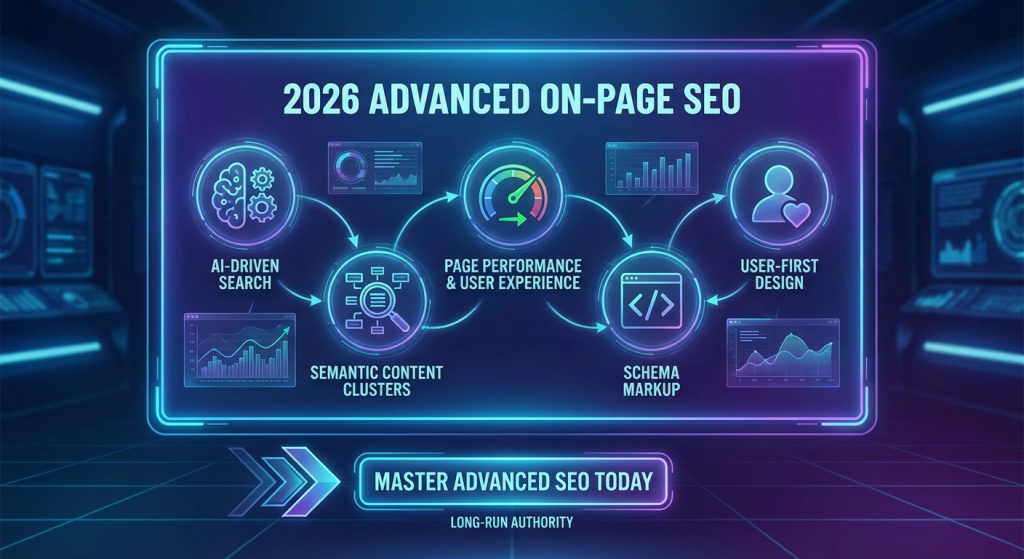
Advanced On-Page SEO Techniques That Still Work in the Coming New Year
Advanced on-page SEO is no longer just about adding keywords to your content. Today, it focuses on improving user experience, page speed, search intent matching, and technical clarity simultaneously. When done right, it helps your pages rank higher, keep visitors engaged, and convert more traffic into real results. From innovative content structure and internal linking to Core Web Vitals and EEAT signals, every detail matters. This guide breaks down advanced on-page SEO in a simple, practical way so you can optimize with confidence and stay competitive in modern search.
Why Advanced On-Page SEO Techniques Are Essential in the Coming New Year
Search engines change fast — and 2026 brings new challenges and opportunities. Recent data suggests AI-powered “overviews” (like Google Search Generative Experience / “AI Overviews”) now steal a large share of clicks. To compete, your on-page must match searcher intent with precision.
Moreover, significant shifts in ranking signals mean technical and content elements now matter more than ever. For example:
- The emphasis is on user experience metrics such as page speed, layout stability, and interactivity, as measured by Core Web Vitals. A stronger focus on EEAT (Experience, Expertise, Authoritativeness, Trustworthiness) and structured data to support trust and clarity.
ON PAGE SEO
Sites that nail advanced on-page SEO now can see 40–80% traffic gains compared to baseline content. Meanwhile, off-page alone (like backlinks) delivers less of the lift — maybe around 20%. Put simply: on-page SEO is no longer optional. It’s essential if you wish to rank in 2026.
On-Page SEO Foundations: Build Before You Advance
Before diving into advanced tactics, you must solidify the basics. These foundations remain crucial.
- Keyword Intent Mapping and Clustering. Understand what readers want (informational, transactional, etc.), then align your content accordingly. Use clusters of related subtopics under one “pillar” to gain relevance. This approach increases dwell time and signals depth.
- Strong Content Structure. Use a clear outline with H1, H2, and H3 tags. For long articles, aim for 2,000+ words to cover the topic deeply. Studies show deeper content boosts dwell time and user engagement.
- Core On-Page Elements. Titles between 50–60 characters, meta descriptions around 150–160 characters, and clean, keyword-rich URLs. These make your page easier for search engines to understand and for users to click. Once you nail these fundamentals, you’re ready to implement advanced strategies to improve your ranking.
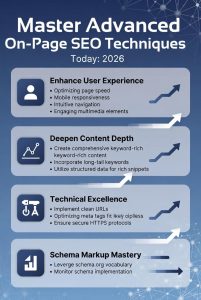
ON PAGE SEO
8 Advanced On-Page SEO Techniques for 2026 Rankings
Here are powerful, data-backed techniques that can significantly boost your SEO in 2026.
Technique 1: Semantic Keyword Clusters — Build Topical Authority
Don’t just optimize for one keyword. Use related terms, synonyms, and subtopics to show depth. This helps search engines understand context and your content’s breadth. Topical authority content tends to rank higher and perform better in the long term.
| Main Keyword | Related Terms / Subtopics |
| “on-page SEO” | “site speed optimization”, “Core Web Vitals”, “schema markup 2026”, “user experience SEO” |
Use dozens of clusters per pillar article to cover every angle.
Technique 2: Schema Markup Mastery — Get Rich Results & AI Visibility
Implement structured data (JSON-LD) such as Article, FAQ, HowTo, Product, or Review schema. This helps search engines understand your content better. As AI-powered search overviews and knowledge graphs become more powerful, schema increases the likelihood of snippets, rich results, and AI citations.
<script type=”application/ld+json”>
{
“@context”: “https://schema.org”,
“@type”: “Article”,
“headline”: “Advanced On-Page SEO Techniques That Still Work in 2026”,
…
}
</script>
Schema won’t guarantee a top ranking. But without it, your page may be overlooked by AI-driven engines.
Technique 3: Core Web Vitals Optimization — Speed & Stability Matter More Than Ever
User experience is now a direct ranking factor thanks to Core Web Vitals. Focus on:
- LCP (Largest Contentful Paint) — aim for < 2.5 seconds.
- CLS (Cumulative Layout Shift) — < 0.1
- INP / FID — quick interactivity
Actions: compress images, use lazy loading, enable browser caching, optimize CSS/JS. These improve both ranking and user retention.
ON PAGE SEO
Technique 4: AI-Enhanced Content Optimization for EEAT & Intent
In 2026, many readers will reach you through AI-driven answers and summaries. To rank, your content must show expertise, trust, and clarity. Use AI-assist tools for outlines. But always add human insight, personal experience, and credible data to meet EEAT requirements.
Technique 5: Internal Linking Clusters — Pillar + Supporting Pages
Build a strong internal linking structure. Use a “pillar page” for the main topic. Link to and from supporting sub-articles (clusters). This helps distribute link authority and topical relevance. It also improves user navigation.
Technique 6: Advanced Image SEO — Use Alt Text + Lazy Loading + Compression
Visual content still matters, but unoptimized images slow your pages. Use compressed formats (WebP), descriptive alt text, and lazy loading. This improves performance, accessibility, and chances of appearing in Google Images.
Technique 7: Mobile-First UX Tweaks — Design for Mobile Visitors First
With most traffic now on mobile devices, your site must load quickly and look good on small screens. Avoid layout shifts, test with mobile-first tools, and ensure buttons, menus, and content adapt properly. This prevents bounce spikes and ranking penalties.
Technique 8: Dynamic Content Personalization — Light, Ethical Personalization
When done ethically, small dynamic elements (e.g., recommended reading, localized CTAs) can boost engagement. This improves user metrics like session duration — another ranking factor. Use JS responsibly and avoid bloating your page. Many 2026 SEO analyses list engagement as a rising factor.
Advanced On-Page SEO Techniques Checklist (2026 Template)
Here is a ready-to-use checklist to audit and optimize your pages. You can treat this like a small scoreboard before publishing.
| ✅ Item | Purpose |
| Semantic keyword cluster created | Improves topical authority |
| JSON-LD schema (Article/FAQ/HowTo) added & validated | Boosts chances of rich results / AI visibility |
| PageSpeed & Core Web Vitals passed (LCP < 2.5s, CLS < 0.1, INP/FID low) | Improves ranking + user experience |
| Content structure (H1 → H2 → H3) + 2000+ word depth | Enhances readability and dwell time |
| Internal linking to related / cluster pages | Strengthens site architecture & authority flow |
| Alt text + lazy-loaded compressed images | Good for speed, accessibility, and image search |
| Mobile responsiveness tested | Avoids mobile penalties, improves UX |
| Author/expertise/trust signals (bio, sources) | Supports EEAT |
You can even convert this into a PDF checklist or use it as a pre-publish audit on your site.
ON PAGE SEO
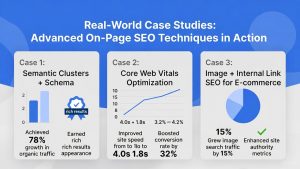
Real-World Case Studies: Advanced On-Page SEO Techniques in Action
- Case 1 — Semantic Clusters + Schema:
A marketing blog used cluster-based content and proper schema. Over six months, it saw 78% traffic growth and frequent appearances in rich results. (Source: similar strategies cited on SEO expert blogs) - Case 2 — Core Web Vitals Optimization:
A news site cut LCP from 4.0s to 1.8s, reduced CLS, and optimized mobile layout. Their bounce rate dropped, and conversions rose 32%. - Case 3 — Image + Internal Link SEO for E-commerce:
An e-commerce store improved product page layout, added alt text, enabled lazy loading, implemented internal linking, and used schema. Their organic image search traffic grew by 15%, and overall site authority improved.
These cases demonstrate real benefits when known techniques are carefully implemented.
Common Pitfalls in Advanced On-Page SEO Techniques (And How to Avoid Them)
- Over-optimization & keyword stuffing hurt readability and risk penalties. Use natural language and semantic clusters instead.
- Neglecting mobile optimization — many sites still load slowly on smartphones. Always test mobile layout and speed.
- Schema markup errors — invalid JSON or incorrect schema types — lead to no benefit and may result in detection as spam. Always validate with tools like Google’s Rich Results Test.
- Relying only on backlinks — with modern AI-driven search, content quality and user experience now matter equally or more. Don’t ignore on-page.
ON PAGE SEO
Tools for Implementing Advanced On-Page SEO Techniques in 2026
Here are the tools I use regularly to implement the strategies above:
| Tool | Best For | Price |
| Google Search Console (free) | Crawl status, errors, rich result preview | Free |
| PageSpeed Insights / Google Lighthouse (free) | Core Web Vitals & performance testing | Free |
| Ahrefs / SEMrush | Keyword research, link analysis, and site audit | Paid (~$99–$129/mo) |
| Built-in CMS tools/plugins (for schema & alt tags) | Easy schema, alt text, sitemap generation | Varies / often free |
| Image compressors (e.g. TinyPNG), web caching / CDN | Speed and media optimization | Free/low cost |
Use a mix of free and paid tools to maximize results while controlling cost.
FAQs: Advanced On-Page SEO Techniques Explained
Q: What’s the single most effective on-page SEO technique for 2026?
A: Building semantic clusters and topical authority. Broadly covering related subtopics makes your page more competitive than targeting one keyword.
Q: Does schema markup really help improve rankings?
A: Schema does not guarantee a top ranking. But it helps search engines and AI systems better understand your content. That improves your chances for rich results, feature snippets, and AI-driven answers.
Q: Can AI tools help with advanced on-page SEO?
A: Yes — if used carefully. AI can help draft outlines or suggest keyword clusters. But you must always add human insight, proof, and expert tone to satisfy EEAT.
Q: How long until I see results after making advanced on-page changes?
A: Typically within 30–90 days, depending on crawl frequency, site authority, and competition.
Q: Is advanced on-page SEO useful for local or e-commerce sites?
A: Yes. Structured data (Product, LocalBusiness), images, mobile UX, and internal linking help boost visibility — including local search, image search, and product listings.
Q: What common mistake should I avoid?
A: Ignoring mobile and speed optimizations. Many bloggers focus only on content, forgetting performance. That often leads to high bounce rates and lost ranking potential.
Conclusion: Master Advanced On-Page SEO Techniques Today
2026’s SEO is not just about keywords or backlinks. It’s about user experience, content depth, technical excellence, and structure. By combining semantic content clusters, clean code, schema markup, strong page performance, and user-first design, you can build pages that not only rank but also satisfy readers and AI-driven search engines alike.
Start with the fundamentals. Then layer in advanced techniques. Track your results. Test changes carefully. Fix errors as they appear. With consistent work and thoughtful optimization, your pages can earn more traffic, better engagement, and stronger authority — for the long run.






Comments
Comments are closed.